Netanyahu and Eisenkot Conclude Two-Hour Unity Talks at Tel Aviv Military Headquarters; No Official Outcome Announced
Yugcharan News / 29-11-2026
Israeli caretaker Prime Minister Benjamin Netanyahu and Yashar party leader Gadi Eisenkot concluded a meeting of about two hours on Sunday, 29 November 2026, at the Kirya military headquarters in Tel Aviv, on a possible national-unity government. The Jerusalem Post, in an update issued at 1.09 p.m. Israel time (4.39 p.m. IST), said the two men held a two-hour meeting. Ynet reported that the session finished after approximately two hours, having begun around 10 a.m. local time (1.30 p.m. IST) with a security briefing, according to Mr Eisenkot's office. The Times of Israel, citing Hebrew-language media at 12.10 p.m. Israel time (3.40 p.m. IST), likewise said the meeting had ended after some two hours and that there was no immediate word on the outcome. As of an early-evening IST check on Sunday, The Jerusalem Post, Ynet, The Times of Israel and the BBC had confirmed that the talks had taken place, but none of those outlets had reported an official result or a joint statement from the two sides or their offices.
The meeting had originally been set for 10 a.m. at a hotel in the coastal city of Herzliya, a time and place Likud, Mr Netanyahu's party, gave in a statement late on Saturday, 28 November, according to an AFP report carried by The Hindu. Ynet identified the original site as the Dan Accadia Hotel. Mr Eisenkot's Yashar party announced on Sunday morning that the venue had been moved to the Kirya, The Jerusalem Post and The Times of Israel reported. AFP, in a later Sunday despatch, said the talks would be held at the defence ministry in Tel Aviv and would begin with a briefing on Israel's security situation, according to Eisenkot's party. The Kirya, as those reports use the name, is the defence compound in Tel Aviv.
Who was present, and what else was under way
Ynet reported that former minister Ron Dermer, described by the site as a close confidant of Mr Netanyahu, joined the Kirya meeting after the security briefing had ended. The Jerusalem Post gave a similar sequence: it said Mr Netanyahu's military secretary was initially present but left shortly after the session began, and that Mr Dermer, who the paper said was mediating the talks, then joined. The Times of Israel, citing Hebrew-language reports earlier in the morning, had likewise said Mr Dermer entered once the defence update had finished. Those accounts differ from some earlier reports that had placed him in the room from the outset; this article follows the later, more specific sequence given by Ynet and The Jerusalem Post.
The Jerusalem Post, citing a Yashar announcement, said a separate meeting between the negotiating teams of Yashar and Naftali Bennett's B'Yachad party was under way at the same time as the leaders' session. In its Sunday afternoon update, the paper added that the B'Yachad meeting with Yashar representatives was still going on and had continued for more than three hours, and that there were reports of major progress between those two sides. That is how The Jerusalem Post recorded the parallel talks; it is not an official statement that an agreement had been signed. The paper's Sunday live coverage also said protesters gathered outside the Kirya and called for a unity government while the two leaders met.
Ynet wrote that, during Sunday's meeting, Mr Netanyahu apparently asked that any rotation take effect only after he had dealt with what the site called a "sensitive security event" in the near future, and that Mr Eisenkot's party rejected such a condition. The Times of Israel had earlier cited similar Ynet reporting. This article records that as reporting by those outlets, not as an official statement from either party on the outcome of the talks, which had not been issued when this copy was checked.
The rotation offer that led to Sunday's meeting
In a social media post late on Saturday, Mr Netanyahu, described by AFP as Israel's longest-serving premier, said, as quoted by The Hindu: "My responsibility as a leader requires me to set everything aside... and agree that Gadi Eisenkot will serve first as prime minister, while I will serve as alternate prime minister at the beginning of the term." The BBC rendered the opening of the same post as an obligation "to put everything aside, including the principle of the largest party," and said he would initially serve as alternate prime minister. The two translations cover the same Saturday message.
The BBC also quoted Mr Netanyahu as saying he was making the proposal because of "the magnitude of the existential danger and the possibility that a government will be formed that does not have the capacity to deal with this danger." That is his stated reason. This report does not assess that claim. Mr Eisenkot, a former army chief and chairman of Yashar, responded that if Likud was ready for "genuine unity," he was prepared to see how serious it was over the next 24 hours, The Hindu reported. The Jerusalem Post quoted a similar wording: "If Likud is genuinely committed to unity, I am prepared to assess its seriousness over the next 24 hours." The BBC, in a Sunday report that described the two men as having held talks, said he invited Mr Netanyahu to "genuine and accelerated negotiations," and that talks would be on a "detailed proposal" sent to Mr Netanyahu the previous Sunday. "To this very moment, we have received no response," Mr Eisenkot said, according to the BBC. On Friday he had accused Likud of stalling and of refusing, over two weeks, to put a concrete proposal on the table, both AFP and the BBC reported.
Ynet reported a further procedural point: the post of alternate prime minister was abolished by legislation in the previous Knesset term, so new legislation would be required to put Mr Netanyahu's proposal into effect. That is a point raised in that coverage, not a decision announced after Sunday's talks.
The parliamentary arithmetic, as reported
Israel's parliament, the Knesset, has 120 seats. A majority requires 61. The country held inconclusive elections in late October, AFP reported, leaving neither main bloc with a majority. The BBC said Mr Eisenkot's centrist Yashar party and three other Jewish opposition parties won 48 seats, while Mr Netanyahu's bloc won 53, both short of 61. The Jerusalem Post's Sunday live page gave a party-level breakdown of the same election: Likud 27 seats, Yashar 21 and B'Yachad 12, with Mr Netanyahu's bloc at 53 and the Eisenkot-led opposition bloc at 48. Those figures are recorded as their sources stated them.
The Hindu, citing AFP, said Yashar had so far agreed coalition deals with the left-leaning Democrats and the right-wing Israel Beiteinu party, and that those partners together had 36 lawmakers, far short of 61. The Jerusalem Post added that Mr Eisenkot had already signed coalition agreements last week with Avigdor Liberman's Yisrael Beytenu party and Yair Golan's Democrats party, which is consistent with that AFP tally of deals already agreed. The 36 figure refers to deals already signed, as reported by AFP and The Jerusalem Post; the 48 figure is the BBC's and The Jerusalem Post's account of the October result for the broader opposition camp. They are not the same count.
The Jerusalem Post said President Isaac Herzog granted Mr Eisenkot the mandate to form a government on 8 November, making this his final week to do so, with the option of requesting a 14-day extension. The legal deadline cited across these reports remains 6 December 2026. The Hindu, citing AFP, said Mr Eisenkot had vowed the day before Sunday's meeting to announce a government by that deadline without using the extension. The Jerusalem Post and Ynet also reported that Mr Eisenkot met Mr Liberman at the Dan Accadia Hotel on Saturday evening, ahead of the Sunday session with Mr Netanyahu.
Naftali Bennett, leader of B'Yachad and a former prime minister, said on Thursday he favoured a unity government involving Likud, with Mr Eisenkot serving first as prime minister, the BBC reported. After Mr Netanyahu's Saturday comments, Mr Bennett said, according to the BBC, that Mr Netanyahu had made the right decision in being willing to join a unity government led by Mr Eisenkot. The BBC noted that two Arab-led alliances together won 19 seats, and that all but one of the Jewish parties had pledged before the election not to work with them to form a government. Those lists remain part of the parliamentary arithmetic. This report does not go into the separate, contested conditions that individual party leaders have set for any future arrangement.
What Sunday's meeting has, and has not, settled
Ynet separately reported that Yashar parliamentary faction chairman Roy Folkman had asked faction leaders in Mr Eisenkot's bloc to keep their lawmakers available for votes through next Monday, with no vote-pairing arrangements and no trips abroad, citing "special preparations for the coming week." The site said the instruction was intended to leave open the possibility that Mr Eisenkot could inform President Herzog as early as this week that he had succeeded in forming a government. That report concerns preparations around the mandate; it is not an official account of what was agreed, or not agreed, in the Kirya meeting.
The BBC recalled that no party in Israel has ever won an outright majority, so every government has been a coalition, and that five elections were held between 2019 and 2022 when rivals struggled to cooperate. Sunday's confirmed two-hour meeting at the Kirya is a development from the Herzliya appointment announced on Saturday. Any joint statement, or a decision to continue or break off further talks, will have to come from the two sides or their parties. As of the early-evening IST check described above, that official word had not been published in the sources used for this report. The legal deadline remains 6 December 2026.
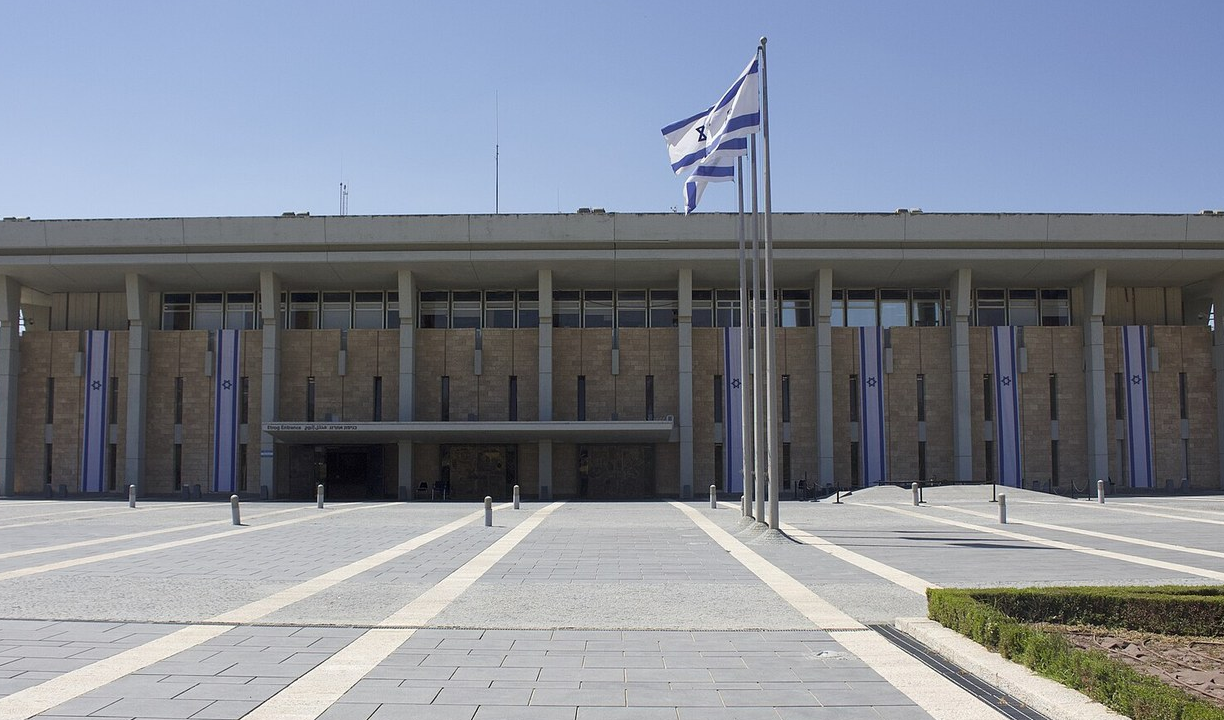
Photo: The Knesset, Jerusalem (file photo, 2022), Clema12, Wikimedia Commons, CC BY-SA 4.0.