Yugcharan News / 19 May 2026
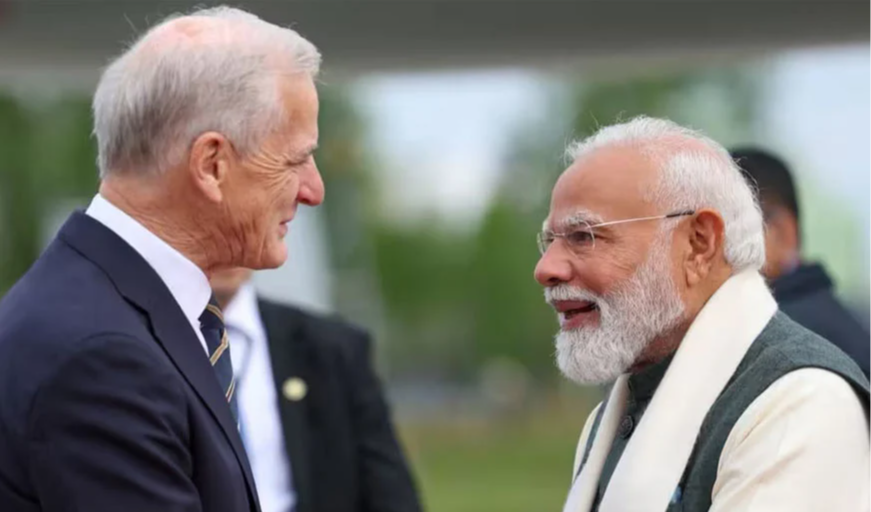
India and the Nordic nations convened for the third India-Nordic Summit in Oslo on Tuesday, with leaders discussing a broad range of strategic, economic, environmental and geopolitical issues at a time of growing global uncertainty. The summit brought together India and the five Nordic countries — Norway, Sweden, Finland, Denmark and Iceland — as both sides seek to deepen cooperation in areas including technology, renewable energy, climate policy, maritime trade and regional security.
The high-level meeting comes against the backdrop of major global developments, including ongoing geopolitical tensions in Europe and West Asia, disruptions in global supply chains, and increasing international competition over emerging technologies and energy security.
Prime Minister Narendra Modi represented India at the summit, while the Nordic bloc was represented by Norwegian Prime Minister Jonas Gahr Store, Danish Prime Minister Mette Frederiksen, Finnish Prime Minister Petteri Orpo, Icelandic Prime Minister Kristrún Frostadottir and Swedish Prime Minister Ulf Kristersson.
The summit also marked the first official visit by an Indian Prime Minister to Norway in more than four decades.
Focus On Strategic Partnerships And Trade Expansion
According to officials and diplomatic sources, strengthening trade and investment cooperation emerged as one of the key priorities during the summit discussions.
India and the Nordic countries have steadily expanded economic engagement over recent years, particularly in green technology, innovation, infrastructure, shipping, clean energy and advanced manufacturing sectors.
Reports indicate that bilateral trade between India and the Nordic region collectively reached nearly 19 billion dollars in 2024. Several major Nordic companies already maintain a significant business presence in India across telecommunications, energy, industrial equipment, transport and retail sectors.
Government representatives from both sides reportedly discussed expanding supply chain partnerships and increasing long-term investments following recent economic agreements involving India and European trade partners.
Analysts believe the summit reflects India’s broader effort to diversify trade partnerships and strengthen economic engagement with technologically advanced nations amid changing global market conditions.
Green Energy And Climate Cooperation
Climate transition and renewable energy cooperation featured prominently during the summit discussions.
Nordic countries are globally recognised for their expertise in sustainability, clean energy innovation and environmentally focused industrial development. Indian officials reportedly explored opportunities for collaboration in renewable energy infrastructure, electric mobility, sustainable urban planning and low-carbon industrial technologies.
Experts say India is particularly interested in leveraging Nordic expertise in areas such as offshore wind energy, geothermal technology, maritime sustainability and green hydrogen development.
Diplomatic observers noted that discussions also covered climate financing, sustainable growth models and international environmental commitments.
Several Nordic leaders reportedly expressed interest in participating in India’s expanding clean energy and green manufacturing sectors, which are expected to attract substantial foreign investment in coming years.
Global Conflicts And Energy Security
The summit took place during a period of heightened international concern over energy security and geopolitical instability.
According to diplomatic observers, the continuing Russia-Ukraine conflict and tensions in West Asia, including the ongoing regional crisis involving Iran and Israel, have significantly affected global energy markets and supply chains.
Sources indicated that leaders discussed ways to reduce vulnerabilities in energy access and strengthen economic resilience amid fluctuating global conditions.
India, which remains one of the world’s largest energy-importing nations, has increasingly focused on securing diversified energy partnerships in recent years.
European nations, including Nordic countries, are also reassessing long-term energy strategies due to global supply disruptions and evolving geopolitical risks.
Policy experts believe the summit provided an opportunity for both sides to align economic and energy strategies while promoting stable and sustainable trade partnerships.
India’s Growing Arctic Interest
One of the significant strategic themes during the summit involved discussions surrounding the Arctic region and India’s expanding interest in Arctic cooperation.
Although India is not geographically part of the Arctic region, it has maintained scientific and strategic engagement there for decades. India currently holds observer status in the Arctic Council and operates research activities in the region through scientific missions and climate studies.
Officials familiar with the discussions indicated that India is seeking greater cooperation with Nordic nations on Arctic research, climate monitoring, maritime connectivity and resource management.
Experts note that the Arctic is increasingly becoming an area of geopolitical importance due to emerging shipping routes, climate change impacts and competition over natural resources.
India has also shown interest in improving connectivity through maritime corridors linking Russian eastern ports with Indian coastal infrastructure.
Observers say New Delhi views Arctic engagement not only through a scientific lens but also as part of broader long-term economic and strategic planning.
Technology And Innovation Partnerships
Technology cooperation emerged as another major area of focus during the summit.
India and Nordic countries reportedly explored collaboration opportunities in semiconductor manufacturing, digital infrastructure, artificial intelligence, cybersecurity and advanced industrial innovation.
Recent agreements involving Indian and European technology companies have accelerated interest in deeper industrial cooperation between the regions.
Diplomatic analysts suggest Nordic countries are viewed as valuable partners for India due to their expertise in innovation ecosystems, digital governance models and research-driven industrial growth.
Several Nordic firms are already participating in India’s manufacturing and technology sectors under long-term investment frameworks.
Officials also discussed possibilities for cooperation in space technology, maritime systems and advanced communication networks.
Bilateral Meetings During European Tour
The summit formed part of Prime Minister Modi’s broader multi-nation European visit aimed at strengthening diplomatic and economic relations with several European countries.
Before arriving in Norway, the Indian Prime Minister visited Sweden and the Netherlands, where bilateral meetings focused heavily on trade, technology partnerships and investment cooperation.
In Sweden, discussions reportedly centred on increasing bilateral trade and strengthening industrial collaboration between the two nations.
Meanwhile, the Netherlands visit included conversations on defence cooperation, maritime security and semiconductor manufacturing partnerships.
Reports also indicated that Indian and Dutch companies signed major technology agreements during the visit.
Following the Norway summit, the Prime Minister is expected to continue diplomatic engagements in Italy as part of the wider European outreach programme.
Discussions Around Press Freedom And Human Rights
The European tour has also attracted international attention over discussions related to press freedom and human rights issues.
During media interactions in parts of Europe, journalists raised questions concerning democratic institutions, minority rights and media independence in India.
Indian diplomatic representatives responded by defending India’s constitutional framework, democratic structure and institutional mechanisms.
Officials stated that India remains one of the world’s largest democracies with a diverse media landscape and established judicial protections.
Political observers noted that such exchanges have increasingly become part of diplomatic interactions between India and Western nations, especially during international visits and joint press engagements.
Despite differences in perspectives on certain political issues, analysts believe both India and European nations continue to prioritise economic cooperation and strategic alignment in multiple sectors.
Strategic Importance Of Nordic Partnership
Experts suggest the India-Nordic partnership is becoming increasingly significant within the broader framework of India-Europe relations.
The Nordic countries, though relatively smaller in population, collectively possess strong economic influence, advanced technological infrastructure and high levels of industrial innovation.
For India, partnerships with Nordic nations provide access to expertise in sustainable growth, clean technology and advanced manufacturing.
For Nordic countries, India represents one of the world’s fastest-growing major economies and an important long-term strategic market.
Policy researchers believe future cooperation may increasingly focus on resilient supply chains, climate adaptation, energy transition and emerging technologies.
The summit also reflects India’s effort to strengthen engagement with multiple European partners independently of broader EU-level negotiations.
Future Outlook
Diplomatic experts believe the India-Nordic Summit is likely to deepen long-term cooperation across sectors including climate policy, digital innovation, trade, shipping, defence technology and Arctic research.
While no major breakthrough announcements were immediately reported, the discussions are expected to contribute toward expanded economic agreements and institutional partnerships in the future.
Observers note that global geopolitical uncertainty, changing trade patterns and technological competition are encouraging countries to build broader and more diversified international partnerships.
The India-Nordic engagement is therefore increasingly being viewed as part of a larger strategic realignment involving economic resilience, sustainability and long-term geopolitical cooperation.
As India continues expanding its international partnerships across Europe, the Nordic region appears set to play a growing role in New Delhi’s global economic and strategic planning in the years ahead.