Yugcharan News / 12-11-2026
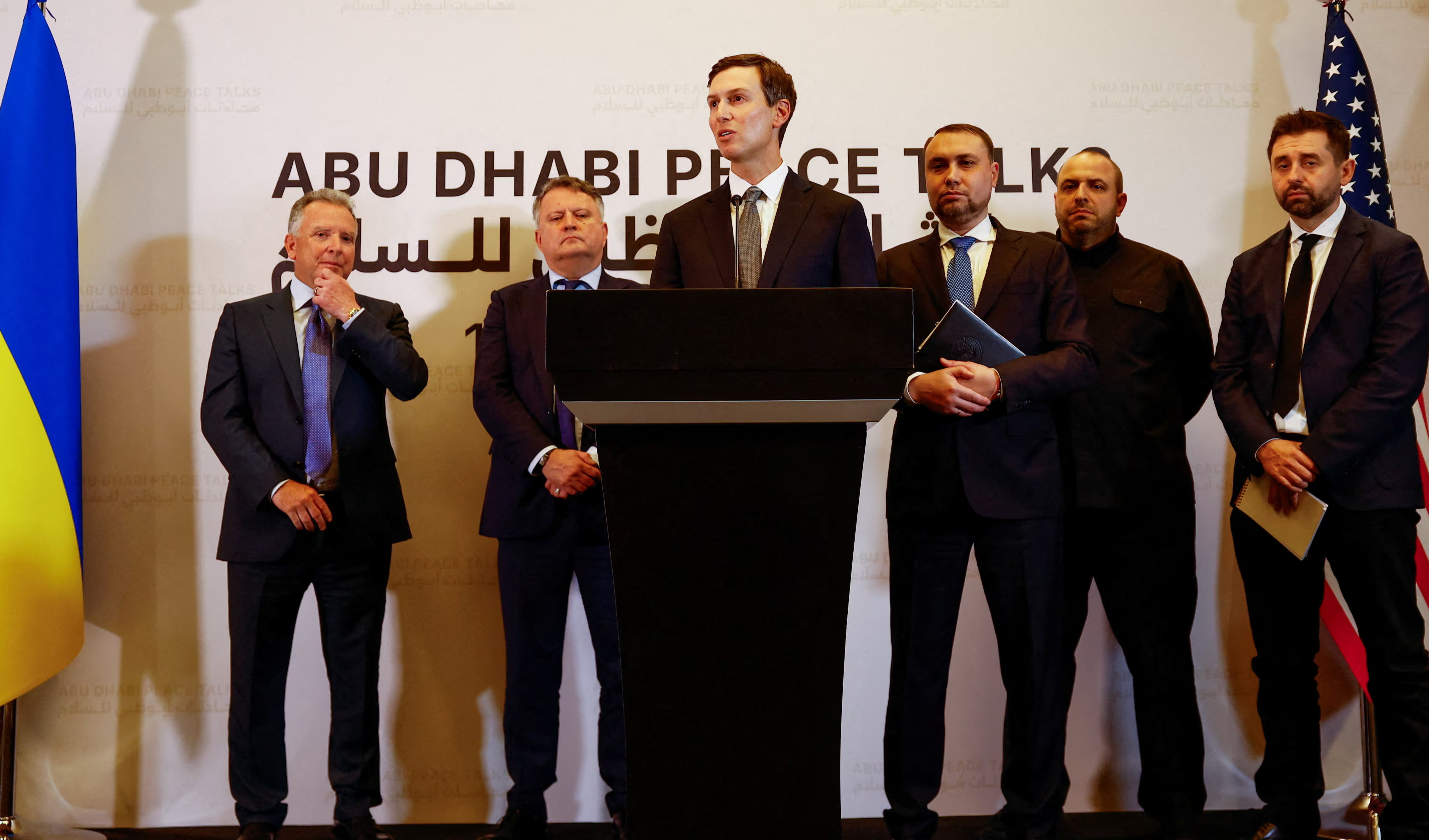
Peace negotiations between Ukraine and Russia, mediated by the United States, entered their second day in Abu Dhabi on Wednesday, November 11, with territorial disputes, security guarantees and possible ceasefire arrangements remaining at the centre of discussions. Although Ukrainian and American officials have described the negotiations as constructive and productive, no breakthrough has been announced, and significant differences between Kyiv and Moscow continue to complicate efforts to end the war.
Ukrainian President Volodymyr Zelenskyy welcomed what he described as a change in the approach adopted by American mediators. Speaking to reporters in Copenhagen on Tuesday, he said he was encouraged by the latest discussions and described them as substantive.
"I see changes. I'm very happy with what I hear," Zelenskyy said, according to the report, while characterising the talks as constructive.
US Secretary of State Marco Rubio also described the negotiations as "very productive". US envoy Jared Kushner said Washington had managed to narrow differences between the two sides, although he did not provide specific details about the progress achieved.
Despite these positive assessments, the negotiations remain difficult because Ukraine and Russia continue to hold sharply different positions on territory, the future security framework for the region and the conditions under which a ceasefire could be implemented.
The discussions in Abu Dhabi are taking place against the backdrop of Russia's full-scale invasion of Ukraine in February 2022, following years of conflict that began in 2014.
Territorial Dispute Remains the Biggest Obstacle
The question of territory continues to be one of the most difficult issues in the negotiations. Moscow is demanding that Ukrainian forces withdraw from eastern regions, including areas that remain under Kyiv's control.
Russia's position on Donbas has been a major point of disagreement. Moscow has continued to seek control over the region, while Ukraine has rejected demands that would require it to surrender territory that its forces still hold.
During the latest discussions, Zelenskyy accused Russian negotiators of presenting an inaccurate picture of the battlefield situation. He said Moscow's representatives had claimed that Russian forces had captured approximately half of the territory in Donbas that remains under Ukrainian control.
According to Zelenskyy, Ukraine's delegation challenged the claims by presenting video evidence. He also said NATO's Supreme Allied Commander Europe, General Alexus Grynkewich, who was present in Abu Dhabi, confirmed that Ukrainian battlefield maps were closer to the actual situation.
The Ukrainian president suggested that Russian President Vladimir Putin might be receiving misleading information about the progress of Russian military operations. Zelenskyy said Putin appeared to believe that Russian forces could capture the remaining Ukrainian-held areas in eastern Ukraine within a few months.
However, Russia has not secured complete control over Donbas despite the prolonged conflict. The dispute over the region has remained central to Moscow's demands and Kyiv's objections throughout the diplomatic process.
Zelenskyy maintained that any final decision on territorial questions would have to be taken by the leaders of the countries involved rather than being settled by negotiators at the working level.
His position indicates that Ukraine does not consider the territorial issue suitable for resolution through technical discussions alone.
Trump Signals Possible Territorial Changes
Ahead of the Abu Dhabi negotiations, US President Donald Trump suggested that Ukraine might eventually have to accept territorial changes as part of a possible settlement.
Trump said Ukraine could end up with a "little bit different shape", indicating that territorial adjustments could form part of the negotiations.
The remark reflects the difficult choices facing the mediators as they attempt to bring the two sides closer to an agreement. Ukraine has consistently emphasised its sovereignty and territorial integrity, while Russia continues to press for control over areas it claims.
Any proposal involving territorial concessions would therefore face significant political and diplomatic challenges in Kyiv.
For Ukraine, the issue is not limited to the immediate battlefield situation. It also concerns the country's internationally recognised borders, the status of occupied territories and the long-term security of areas that could be affected by a settlement.
The negotiations have yet to produce an agreed framework for resolving these competing positions.
Security Guarantees and Europe's Role in the Negotiations
Security arrangements are another major issue being discussed in Abu Dhabi. Washington and Moscow are seeking to address the wider European security framework alongside the immediate question of ending the war.
Kushner said the United States wanted to develop a new security arrangement involving Ukraine, Russia and European countries.
The proposal suggests that Washington is considering a broader framework rather than limiting negotiations to a bilateral settlement between Kyiv and Moscow.
Russia's delegation includes Deputy Foreign Minister Sergei Ryabkov, whose participation has attracted attention because of his previous involvement in Moscow's demands concerning NATO's military presence in eastern Europe.
Before Russia launched its full-scale invasion in 2022, Ryabkov was involved in discussions over Russian demands that NATO roll back its military presence in eastern European countries.
His inclusion in the delegation indicates that Moscow's concerns about the European security structure remain part of the wider diplomatic agenda.
A source within the Russian delegation described ending the war as only one of the issues on Moscow's agenda. This suggests that Russia is seeking to discuss broader questions concerning the regional security environment.
European officials have also travelled to Abu Dhabi for separate consultations. However, they are not formally participating in the trilateral negotiations involving Ukraine, Russia and the United States.
Russian Foreign Minister Sergei Lavrov dismissed the presence of European representatives, saying, "Well, they flew to Abu Dhabi. Let them sit there in the hotel."
Rubio, however, indicated that Europe would eventually need to participate in the negotiations because European countries were "part of solving this problem".
The differing statements highlight an unresolved question about how European governments will be incorporated into any final security arrangement.
For European countries, the outcome of the war and the terms of a possible settlement have direct implications for regional stability, defence planning and the future relationship between Russia and NATO.
De-Escalation Measures and Black Sea Security on Agenda
Wednesday's discussions were expected to focus on practical steps to reduce tensions, including arrangements concerning energy infrastructure and the Black Sea.
Energy facilities have been an important part of the conflict, with attacks and disruptions affecting infrastructure and raising concerns about the security of essential services.
Discussions on energy-related de-escalation measures could provide an opportunity to establish limited arrangements even if the broader territorial dispute remains unresolved.
The Black Sea is another strategically important area. Security in the region has implications for maritime movement, trade, shipping routes and the wider economic interests of both countries.
Any agreement to reduce military activity around energy infrastructure or in the Black Sea could help lower immediate risks. However, such measures would require both sides to agree on their scope, monitoring arrangements and implementation.
The possibility of a trilateral meeting involving the national leaders has also been discussed. Such a meeting could potentially take negotiations beyond the current level of diplomatic engagement.
However, no confirmed announcement of a leaders' meeting was included in the latest report.
Russia Continues to Reject an Immediate Ceasefire
Despite the diplomatic activity, Russia continues to oppose an immediate ceasefire.
Lavrov has accused European governments of seeking to give Ukraine additional time to recover its military losses. Moscow's position reflects its concern that a temporary halt in fighting could allow Kyiv to strengthen its military capabilities before negotiations resume.
Ukraine, meanwhile, has indicated that limited ceasefire arrangements could help create conditions for a broader agreement.
Kyiv has pointed to a humanitarian operation conducted last month in Russian-occupied Oleshky as an example of how limited arrangements can produce practical results. The operation reportedly enabled the delivery of humanitarian assistance and the evacuation of civilians.
Such arrangements could provide a basis for further discussions on reducing violence, protecting civilians and facilitating humanitarian access.
The dispute over an immediate ceasefire remains significant because both sides have different assessments of how a pause in fighting would affect their military and diplomatic positions.
The negotiations have not yet produced an agreement on the timing, conditions or monitoring of a broader ceasefire.
Large-Scale Prisoner Exchange Under Discussion
A possible prisoner exchange has emerged as one of the more concrete areas of discussion.
Zelenskyy said Ukraine and Russia were considering an exchange involving 1,000 prisoners from each side. He also indicated that the number could potentially increase to 1,500 prisoners each.
The proposal would represent a major humanitarian development if both sides reach an agreement.
US officials are expected to travel to Russia for further discussions, according to Zelenskyy. These talks could help clarify the details of a possible exchange, including the number of people involved and the arrangements required for implementation.
The proposal follows negotiations held in Istanbul in May 2025, when Ukraine and Russia agreed to exchange 1,000 prisoners each despite failing to reach an agreement on a ceasefire.
Prisoner exchanges have remained among the few areas where the two sides have been able to achieve tangible results during diplomatic engagements.
Humanitarian arrangements are also important because they can provide relief to affected individuals and families even when wider political disagreements remain unresolved.
However, no new prisoner exchange agreement had been officially announced in the report covering the Abu Dhabi negotiations.
Previous Humanitarian Efforts Offer a Limited Basis for Progress
The history of negotiations between Ukraine and Russia has demonstrated that humanitarian arrangements can sometimes move forward even when broader political and military issues remain unresolved.
Prisoner exchanges and limited humanitarian operations have provided opportunities for cooperation despite continued fighting.
The proposed exchange of 1,000 or potentially 1,500 prisoners from each side could therefore become an important outcome of the latest round of discussions.
Nevertheless, such an arrangement would not resolve the fundamental disagreements over territory, security guarantees or the future relationship between Russia and Ukraine.
The May 2025 Istanbul negotiations similarly produced a prisoner exchange agreement without delivering a ceasefire.
This history underlines the difference between limited humanitarian cooperation and a comprehensive political settlement.
Possibility of a Leaders' Meeting Remains Open
The discussions in Abu Dhabi have also raised the possibility of a meeting at the highest political level.
Zelenskyy has argued that territorial questions ultimately require decisions by national leaders. This suggests that progress at the diplomatic level may not be sufficient to resolve the most sensitive issues.
A meeting involving Zelenskyy, Putin and Trump could potentially provide an opportunity to address questions that negotiators have been unable to settle.
However, the latest discussions have not resulted in a confirmed date or agreement for such a meeting.
The United States continues to play a central mediating role, with Rubio and Kushner involved in the negotiations. Their comments indicate that Washington believes some differences between the parties have narrowed, although the specific areas of progress remain unclear.
The presence of European officials in Abu Dhabi for separate consultations also suggests that the wider regional security implications are being considered alongside the immediate negotiations.
No Breakthrough Yet Despite Positive Diplomatic Signals
The second day of talks has produced encouraging public assessments from Ukrainian and American officials, but the main obstacles remain unresolved.
Ukraine and Russia continue to disagree over the future of Donbas and other territorial questions. Moscow has rejected an immediate ceasefire, while Kyiv is seeking security guarantees and arrangements that could prevent renewed military action.
The role of European countries in a future security framework also remains uncertain. Although Washington has indicated that Europe will need to participate in resolving the conflict, Moscow has questioned the involvement of European representatives.
The proposed prisoner exchange and discussions on energy infrastructure and Black Sea security offer possible areas for limited progress. However, no comprehensive agreement has been announced.
For now, the Abu Dhabi negotiations remain an important diplomatic effort, but their outcome will depend on whether Kyiv and Moscow can bridge differences that have persisted throughout the conflict.