Search

    Language Settings
    Select Website Language

    GDPR Compliance

    We use cookies to ensure you get the best experience on our website. By continuing to use our site, you accept our use of cookies, Privacy Policy, and Terms of Service.

    NSA Ajit Doval at IIT Roorkee: Five Lessons on Knowing Yourself, Taking Risks and Staying True to Values

    5 hours ago

    Yugcharan News / 22-09-2026

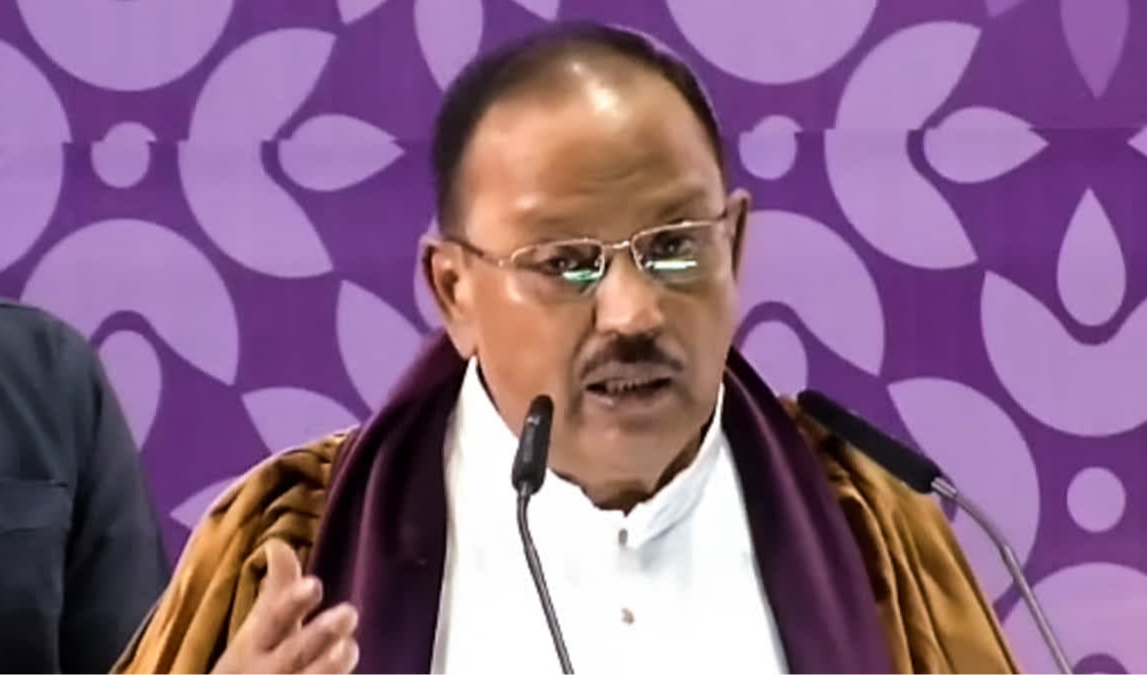
    National Security Advisor Ajit Doval recently addressed graduates at IIT Roorkee, using experiences from his career and stories from history and mythology to reflect on decision-making, self-awareness, ambition, risk-taking and personal values.

    Speaking to students at the institute, Doval emphasised that professional success is not determined simply by academic qualifications or following a predetermined path. Instead, he encouraged graduates to understand their circumstances, identify where they want to go, assess the challenges before them and remain prepared to adapt as conditions change.

    A central theme of his address was the balance between audacity and responsibility. Doval said that taking risks can create opportunities for significant achievements, but ambition should not come at the expense of responsibility or values.

    Here are five key lessons highlighted during his address.

    1. Understand Where You Stand

    Doval recalled an incident from his early intelligence career in Sikkim to explain the importance of knowing one's current position before deciding where to go.

    He described a conversation with a Sherpa friend who explained the importance of understanding a map. Before a person can identify the route to a destination, the starting point has to be clear.

    Doval connected that lesson to personal life, saying that people need to understand themselves before deciding their direction. An individual's thoughts, emotions, strengths and weaknesses can change over time, meaning self-understanding is not something that can be completed once and then ignored.

    The message was particularly relevant for students beginning their professional lives. Their abilities, interests and circumstances may change as they gain experience, and regular self-assessment can help them respond to those changes.

    Doval recalled the Sherpa's explanation: "It's all about reading your map. In life, some read it right, some read it wrong."

    The metaphor suggests that understanding one's present circumstances is an important first step in making meaningful decisions. Without knowing the starting point, even a clearly defined destination can remain difficult to reach.

    2. Be Clear About Where You Want to Go

    According to Doval, understanding the starting point is only part of the process. A person also needs clarity about the destination.

    He recalled his Sherpa friend's three-part explanation of navigating through life: first determine where you are, then identify where you want to go, and finally work out how to get there and, if necessary, how to return.

    Doval told the graduates that the same principle can be applied to careers and personal decisions.

    Having a goal, however, does not mean following a fixed plan regardless of circumstances. Goals may need to be reviewed as situations evolve.

    The distinction is important for young professionals entering an uncertain environment. A career path may change because of new opportunities, unexpected difficulties, changing interests or developments outside an individual's control.

    Doval's message was therefore not simply about setting ambitious goals but about understanding the relationship between the present position, the desired destination and the route required to move between the two.

    The map analogy also places emphasis on preparation. Knowing where one wants to go does not automatically reveal the obstacles along the way. The route has to be understood, evaluated and adjusted when circumstances change.

    3. Make Informed Decisions and Keep Reassessing

    Another major theme of Doval's address was decision-making.

    He told students that people generally do not deliberately choose a course of action believing that it is wrong. Mistakes are often recognised only after circumstances change or the consequences become clear.

    However, Doval distinguished between making an informed decision and making an uninformed one.

    He encouraged students to study the situation around them, understand the circumstances and consult people with relevant experience before taking important decisions. Rather than relying entirely on chance, he said individuals should gather information and think carefully about the available options.

    Doval also stressed that people themselves change over time.

    "You are not what you were five years back. You are not that today. Anything that changed in the past would change in the future. Be prepared for that and keep on evaluating and reassessing," he told the students.

    The point reflects the changing nature of both individuals and their surroundings. A strategy that made sense several years ago may not remain appropriate when circumstances, responsibilities or objectives have changed.

    For graduates beginning a new stage of life, this approach places emphasis on flexibility rather than assuming that one decision will determine the entire course of a career.

    4. Accept Risk When the Potential Gains Demand It

    Doval also spoke about the relationship between risk and achievement, using a story from the Ramayana to illustrate the point.

    In his account, Vishwamitra approached King Dasharatha seeking protection from demons near his cottage. Doval referred to a choice between two routes — one longer but comparatively safe, and another shorter but involving greater danger.

    According to the story as presented by Doval, Bharat preferred the longer and safer route, while Ram chose the more difficult path and accepted responsibility for ensuring that Vishwamitra reached his destination safely.

    Doval said he had often wondered why Vishwamitra chose Ram over Bharat in the story. He associated Ram's choice with what he described as "audacity" — the willingness to confront risks in pursuit of a larger objective.

    He linked this quality to people who achieve significant results in different fields.

    "If you don't do it, your life is safe. You can live it well. You will have no big gains, you will have no big pains. Don't bother. But if you have to have those big gains, you have to be prepared for big pains," Doval said.

    His message was that meaningful achievements can sometimes require people to leave familiar and comfortable paths. At the same time, the emphasis was on accepting risk consciously rather than acting without considering consequences.

    5. Ambition Must Be Balanced With Responsibility

    The final message of Doval's address focused on values.

    While encouraging students to be ambitious and willing to take risks, he also stressed that courage and ambition should be accompanied by responsibility.

    He cautioned that the pursuit of success should not result in abandoning principles or ethical standards.

    "The world is yours. It is waiting for you. It is waiting to be conquered. It is waiting for you to build up your reign. Be audacious. But don't forget to be responsible, and never abandon your values," Doval told the graduating students.

    The statement brought together the major themes of his speech.

    Self-awareness helps a person understand their starting point. A clear objective provides direction. Informed decision-making helps in choosing a route. Willingness to accept calculated risks can open opportunities, while responsibility and values provide boundaries for how those opportunities are pursued.

    A Message Beyond the Campus

    Although Doval delivered the address to graduates at IIT Roorkee, the themes he discussed extended beyond academic and professional life.

    The idea of "reading your map" can be applied to decisions involving education, careers, relationships, finances and other areas where people need to understand their circumstances before choosing a direction.

    Similarly, his emphasis on reassessment recognises that personal circumstances are rarely static. A decision that appears appropriate at one stage may need to be reconsidered when new information becomes available.

    His discussion of risk also presented a distinction between a completely safe approach and one that involves uncertainty in pursuit of a larger objective. Doval's remarks suggested that significant gains can involve significant challenges, while his concluding emphasis on responsibility placed a limit on ambition.

    For students graduating from an institution such as IIT Roorkee, the transition from campus to professional life can involve decisions that do not have straightforward answers. Doval's speech presented decision-making as an ongoing process rather than a single choice.

    The five themes — knowing where one stands, identifying where one wants to go, understanding the situation, being prepared to take risks and maintaining values — formed the central message of his interaction with the graduates.

    His address ultimately encouraged students to approach the future with both ambition and awareness, while remaining willing to reassess their direction as circumstances evolve.

    Click here to Read More
    Previous Article
    Maharashtra FDA Suspends Food Licences of Swiggy Instamart, Amazon Warehouse in Mumbai Over Hygiene Violations
    Next Article
    DigiYatra for International Flights: Trials May Begin at Delhi, Mumbai, Bengaluru Airports From October

    Related National Updates:

    Are you sure? You want to delete this comment..! Remove Cancel

    Comments (0)

      Leave a comment