Search

    Language Settings
    Select Website Language

    GDPR Compliance

    We use cookies to ensure you get the best experience on our website. By continuing to use our site, you accept our use of cookies, Privacy Policy, and Terms of Service.

    Tamil Nadu Government Secures Confidence Vote Amid Opposition Walkout and Assembly Tensions

    10 hours ago

    Yugcharan News / 13 May 2026

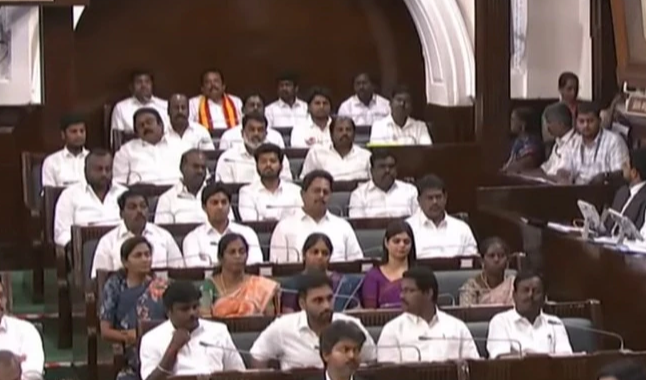
    The newly formed government led by actor-turned-politician C. Joseph Vijay successfully proved its majority in the Tamil Nadu Legislative Assembly on Wednesday after securing support from 144 legislators during a high-voltage confidence vote that witnessed dramatic political exchanges, opposition protests, and visible divisions within the AIADMK camp.

    The trust motion, moved by Chief Minister Vijay shortly after the Assembly convened for the day, was passed comfortably with 144 members voting in favour of the government. Twenty-two legislators opposed the motion, while five members chose to abstain. The vote marked the first major legislative test for the Tamilaga Vettri Kazhagam (TVK)-led administration since it assumed office following the recently concluded Assembly elections.

    The proceedings inside the House remained tense throughout the day, especially after members of the principal opposition party, the DMK, staged a walkout during the debate. The session also drew attention due to the open support extended to the government by a faction of rebel AIADMK legislators led by senior leaders S.P. Velumani and C.Ve. Shanmugam.

    Opposition Walkout Intensifies Political Atmosphere

    Leader of the Opposition Udhayanidhi Stalin launched a sharp attack on the newly formed administration while speaking during the confidence motion debate. He questioned the government’s claim of representing “clean politics” and criticised the recent political developments involving AIADMK rebels supporting the ruling side.

    According to Assembly proceedings, the DMK leadership alleged that the government did not possess a clear majority on its own and depended heavily on support from smaller parties and breakaway legislators. Opposition leaders also accused the ruling dispensation of prioritising political management over governance.

    During his address, Udhayanidhi Stalin reportedly remarked that governance should move beyond social media appearances and focus on administrative delivery. Soon after completing his speech, DMK legislators collectively walked out of the House, refusing to participate in the voting process.

    The walkout significantly altered the arithmetic inside the Assembly, making the confidence vote smoother for the ruling coalition.

    AIADMK Rift Becomes Visible on Assembly Floor

    One of the biggest developments of the day was the visible split within the AIADMK ranks. While AIADMK general secretary Edappadi K. Palaniswami announced that his faction would oppose the trust vote, another group of legislators led by S.P. Velumani openly extended support to the government.

    The disagreement created heated scenes inside the Assembly. Sources indicated that AIADMK members objected when Speaker J.C.D. Prabhakar allowed Velumani to speak during the proceedings. The Speaker, however, maintained that he possessed the authority to recognise any member in the House.

    Velumani later declared that his faction was supporting the trust motion in view of what he described as the people’s mandate for political change in Tamil Nadu.

    Political observers noted that the rebellion within the AIADMK may have long-term implications for opposition politics in the State. The floor test effectively exposed the widening divide between the Palaniswami camp and leaders who have recently distanced themselves from the party’s central leadership.

    Final Vote Tally and Party-Wise Support

    A total of 171 legislators participated in the trust vote after the opposition walkout. The ruling side received support from TVK legislators along with allied parties and rebel lawmakers.

    Among those backing the motion were members from Congress, CPI, CPI(M), VCK, IUML, and the Velumani-led AIADMK faction. An expelled MLA associated with the AMMK also voted in favour of the government.

    Meanwhile, legislators belonging to the Edappadi Palaniswami-led AIADMK faction voted against the motion. The PMK and BJP refrained from supporting either side and abstained during the voting process.

    The final outcome provided immediate stability to the newly formed administration and allowed the Chief Minister to continue without uncertainty regarding legislative numbers.

    Chief Minister Promises “Secular and Inclusive” Governance

    Replying to the debate before the vote, Chief Minister Vijay assured the Assembly that his government would function in a secular and inclusive manner. He also stated that welfare schemes introduced by previous administrations would continue without disruption.

    During his speech, Vijay attempted to counter allegations of political inducement by asserting that his administration would focus on governance rather than political bargaining. He said the new government intended to move forward with speed and transparency.

    The Chief Minister further emphasised that public expectations were high following the recent elections and that the administration intended to honour the promises made during the campaign.

    Following the successful vote, senior TVK leaders thanked alliance partners and supporting legislators for helping the government secure a stable majority in the Assembly.

    Debate Over Appointments and Administrative Decisions

    Apart from the confidence vote itself, several opposition leaders raised concerns over recent appointments made by the government. Discussions intensified around the appointment of a party spokesperson and astrologer, Rickey Radhan Pandit Vettrivel, as an Officer on Special Duty (OSD) to the Chief Minister.

    Leaders from parties including DMDK and Manithaneya Jananayaga Katchi questioned the message such appointments could send regarding governance priorities.

    Some members argued that government functioning should remain rooted in constitutional and administrative principles rather than personal beliefs. Ministers from the ruling side defended the appointment, stating that the individual concerned had long served as the party’s media representative and organisational supporter.

    The issue triggered broader discussions inside the Assembly on governance standards, political symbolism, and public perception during the early days of the administration.

    NEET Cancellation Issue Echoes in Assembly

    The Assembly session also witnessed discussion surrounding the National Eligibility cum Entrance Test (NEET), after reports emerged that the 2026 medical entrance examination had been cancelled amid alleged irregularities.

    Several members urged the new government to adopt a firm stand on the issue. Legislators from regional parties argued that concerns related to NEET had repeatedly affected students in Tamil Nadu and called for measures protecting the interests of State students.

    Some speakers also requested the continuation of welfare and education schemes introduced by earlier governments, including programmes linked to school education, women’s welfare, and public transport assistance.

    The debate highlighted how education policy and entrance examinations continue to remain emotionally and politically significant issues in Tamil Nadu politics.

    Speaker Faces Scrutiny Over Conduct of Proceedings

    Speaker J.C.D. Prabhakar’s handling of the proceedings also attracted criticism from sections of the opposition. AIADMK leaders alleged that allowing rebel legislators additional speaking opportunities violated Assembly traditions.

    However, the Speaker maintained order during several heated exchanges and oversaw the voting process amid visible disruptions from rival factions.

    Before the commencement of voting, Assembly doors were reportedly closed and members were instructed to remain seated to ensure an orderly division process.

    Despite interruptions and loud protests at various points, the voting exercise concluded without major procedural disruption.

    Political Significance of the Floor Test

    The successful trust vote represents an important political milestone for Vijay, whose transition from cinema to active politics has drawn national attention over recent months. While the TVK emerged as a major force during the elections, questions regarding alliance management and legislative stability had continued after the fractured verdict.

    By securing support from multiple parties and rebel legislators, the government has temporarily strengthened its position inside the Assembly. However, analysts believe the developments may further intensify political realignments within opposition parties, particularly the AIADMK.

    The floor test also underlined the shifting political landscape in Tamil Nadu, where newer political formations are attempting to challenge the traditional dominance of the State’s established Dravidian parties.

    With the confidence motion now cleared, attention is expected to shift toward cabinet functioning, policy decisions, alliance dynamics, and administrative delivery in the coming months.


    The Assembly was later adjourned indefinitely following completion of the trust vote proceedings.

    Click here to Read More
    Previous Article
    विवेकानंद ग्लोबल यूनिवर्सिटी और पी.आर.सी.आई , जयपुर चैप्टर के बीच हुआ एमओयू
    Next Article
    NEET UG 2026 Cancellation Sparks Nationwide Probe Into Alleged Examination Leak Network

    Related Politics Updates:

    Are you sure? You want to delete this comment..! Remove Cancel

    Comments (0)

      Leave a comment