Yugcharan News / 25-09-2026
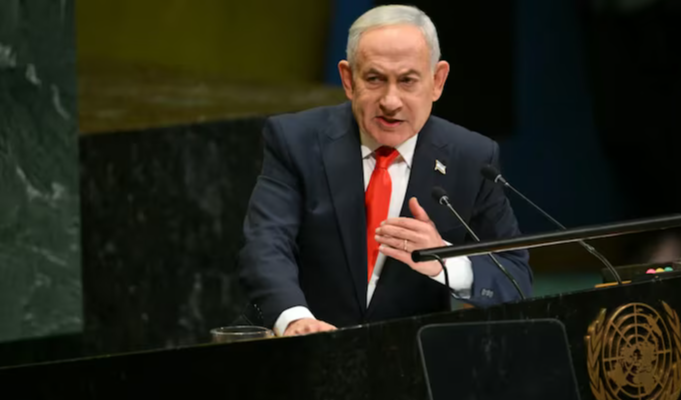
Israeli Prime Minister Benjamin Netanyahu delivered a combative address at the United Nations General Assembly on Thursday, sharply criticising opponents and several Western partners while defending Israel’s military actions in the region. His speech was met by a walkout of dozens of delegates, while protesters gathered outside the United Nations headquarters in New York.
Netanyahu used the international platform to attack Iran, Turkey, Britain, France and New York Mayor-elect Zohran Mamdani, while also defending Israel’s conduct during its military campaign against Iran and its wider conflict with Hamas.
The Israeli prime minister is facing an election in Israel on October 27, adding a domestic political dimension to his appearance in New York. Reuters reported that Netanyahu was seeking to defend Israel’s actions and respond to growing international criticism ahead of the vote.
As Netanyahu began speaking, officials from several countries left the General Assembly chamber. He responded by accusing those who remained of having more courage and called on other delegates who disagreed with him to leave as well. His supporters applauded during the address, while the proceedings were at times disrupted by protests and calls for order.
Netanyahu Criticises Mamdani
One of the most direct attacks in Netanyahu’s speech was aimed at Zohran Mamdani, the mayor-elect of New York City.
Netanyahu accused Mamdani of antisemitism and said many Jewish residents no longer felt safe in the city following his election. He also criticised Mamdani’s opposition to Israel’s military actions in Gaza.
Mamdani has previously criticised Netanyahu and Israel’s military campaign in Gaza. Following the UN address, he responded by accusing Netanyahu of using his speech to repeat what Mamdani described as false claims concerning Israel’s actions and the situation in Gaza.
The dispute between the two has become increasingly public in recent months. Netanyahu had previously criticised Mamdani over his comments about Israel, while Mamdani has said he would seek to enforce an International Criminal Court arrest warrant against Netanyahu if he had the legal authority to do so. The source material notes that Mamdani later acknowledged he did not possess such authority.
The International Criminal Court issued arrest warrants in 2024 for Netanyahu and former Israeli defence minister Yoav Gallant, saying there were reasonable grounds to believe they were responsible for alleged war crimes and crimes against humanity in connection with the Gaza conflict. Netanyahu has rejected the allegations against him.
Britain and France Come Under Fire
Netanyahu also directed strong criticism at Britain and France, two countries that have historically maintained close relations with Israel but have become increasingly critical of its policies.
Both Britain and France have imposed limited sanctions connected to Israeli exports from the occupied West Bank, according to the source material. French President Emmanuel Macron has also taken a more critical position on Israel and played a role in a Western push to recognise a Palestinian state.
During his UN address, Netanyahu rejected accusations that Israel was engaged in colonialism and pointed to the colonial histories of Britain and France. He questioned how those countries could accuse Israel of colonialism when they had themselves played major roles in the colonial era.
Netanyahu and Macron have had strained relations over the Gaza conflict and the question of Palestinian statehood. Macron has been among Western leaders advocating greater international recognition of Palestine, a position that has drawn strong criticism from the Israeli government.
The confrontation at the UN therefore reflected a broader deterioration in relations between Israel and some of its traditional Western partners.
Iran at the Centre of Netanyahu’s Speech
Iran was another major focus of Netanyahu’s address.
He described Iran’s leadership in extremely harsh terms and defended the military campaign conducted by Israel and the United States against Tehran. Netanyahu argued that the operation was necessary to prevent Iran from developing nuclear weapons.
He said stopping Iran from obtaining nuclear weapons remained a central Israeli objective and argued that the military campaign had prevented Tehran from advancing its nuclear capabilities.
The source material says Israel and the United States have been involved in the conflict with Iran for close to seven months. Netanyahu presented the campaign as a response to what Israel considers a serious threat from the Iranian government.
Iran, however, has continued to retain control of its government despite the military campaign. The source also states that Tehran continues to exert control over the Strait of Hormuz, an important global shipping route.
The conflict around Iran has broader international implications because the Strait of Hormuz is a critical route for energy shipments. Disruption in the area can affect oil supplies and energy prices around the world.
Netanyahu Displays Pager During UN Address
One of the most striking moments of Netanyahu’s speech came when he held up a pager while discussing Hezbollah and Israel’s past operations against the Iran-backed Lebanese group.
Netanyahu referred to pagers that, according to reports cited in the source material, were engineered with explosives before being supplied to Hezbollah operatives. The devices were later detonated, causing injuries and deaths among Hezbollah members as well as civilian bystanders.
The reference was to the September 2024 pager explosions that targeted Hezbollah members in Lebanon. The operation became one of the most widely discussed covert actions connected to the Israel-Hezbollah conflict.
Netanyahu’s decision to physically display a pager during his UN speech was intended to remind the international audience of Israel’s campaign against Hezbollah and what his government describes as efforts to counter threats from Iran and groups aligned with Tehran.
The episode also drew attention because the UN address was already taking place amid sharp international disagreement over Israel’s military actions across the region.
Turkey and Erdogan Also Targeted
Netanyahu also criticised Turkey and its President Recep Tayyip Erdogan.
He accused Ankara of supporting Hamas and referred to Erdogan in strongly critical terms. Turkey has been an outspoken critic of Israel’s military campaign in Gaza and has repeatedly called for an end to the fighting.
The dispute between Netanyahu and Erdogan has intensified over the Gaza conflict. Turkey has supported Palestinian causes and has sharply criticised Israel’s military operations, while Israel has accused Ankara of supporting Hamas.
Netanyahu’s comments placed Turkey alongside Iran and other regional actors that Israel regards as hostile or supportive of organisations opposed to the Israeli government.
Protests Outside the UN
Netanyahu’s speech also triggered demonstrations outside the United Nations headquarters.
Protesters gathered with banners criticising Israel’s actions and calling for an end to the war. Several demonstrators were detained during the protests, including Hollywood actor Susan Sarandon, according to the source material.
Inside the General Assembly, the walkout by dozens of envoys created another highly visible moment of opposition. Reuters reported that the departures took place as Netanyahu began his address and that the Israeli prime minister responded by describing those who walked out as “moral cowards”.
The scene illustrated the divisions surrounding Israel at the United Nations, where the Gaza war and the wider regional conflict have become major sources of diplomatic disagreement.
Palestinian President Abbas Unable to Attend
Palestinian President Mahmoud Abbas was also absent from the UN gathering after the Trump administration refused to grant him a visa, according to the source material.
Abbas criticised the decision in a video message played before Netanyahu’s speech. He rejected what he described as unlawful punitive measures and disputed the reasons given for the visa decision.
The absence of the Palestinian leader came as the issue of Palestinian statehood remained a major subject of debate at the United Nations.
The diplomatic disagreement between Israel and several Western countries has grown alongside moves by some governments to recognise a Palestinian state. Netanyahu has strongly opposed such moves, arguing that they undermine Israel’s position and reward Palestinian groups without resolving the conflict.
Netanyahu Returns to Israel Amid Election Campaign
Netanyahu’s visit to New York was brief. According to the source material, he was scheduled to return to Israel after his UN appearance as his country’s election campaign gathers pace.
Israel is due to hold elections on October 27, making the political environment at home an important backdrop to Netanyahu’s international engagements.
His UN speech combined foreign policy, security and domestic political themes. He defended Israel’s military actions, attacked international critics and sought to portray Iran and groups such as Hamas and Hezbollah as major security threats.
At the same time, the walkout by dozens of delegates and the protests outside the UN demonstrated the continuing international disagreement over Israel’s conduct in the region.
The address therefore became more than a conventional diplomatic speech. It served as a platform for Netanyahu to defend his government’s policies, confront critics and present Israel’s position on Iran, Hamas, Hezbollah and the Palestinian issue before a global audience.
With the Gaza conflict and confrontation with Iran continuing to shape international diplomacy, Netanyahu’s remarks are likely to remain part of the wider debate over Israel’s military policies, its relations with Western partners and the future of the Middle East.
The speech also underscored the difficult diplomatic position facing Israel as criticism from some traditional partners increases while Netanyahu continues to defend the country’s military strategy and security priorities. The competing responses inside and outside the United Nations highlighted the sharp divisions that continue to surround the region’s conflicts.