Yugcharan News / 02-09-2026
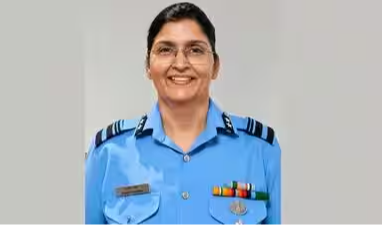
Air Vice Marshal Shakti Sharma has created a significant milestone in the history of the Indian Air Force by becoming the first woman officer from a non-medical branch of the force to attain the rank of Air Vice Marshal, or its equivalent. Her elevation marks another important step in the growing participation of women in senior leadership positions across India’s armed forces.
Sharma has been appointed as the Assistant Chief of the Air Staff (Education), a senior responsibility that places her at the Air Headquarters and gives her an important role in matters connected with education and professional development within the Indian Air Force.
Her appointment was highlighted by the Ministry of Defence as a landmark achievement in the continuing journey of women officers in the Indian defence establishment. With more than three decades of service behind her, Sharma has held a range of assignments involving training, field establishments, command headquarters and Air Headquarters.
A Career Spanning More Than Three Decades
Shakti Sharma was commissioned into the Indian Air Force Education Branch in 1994. Over the years, she served in different capacities and locations, gaining experience across a wide range of institutional and operational environments.
Her career has been notable not only for the senior rank she has now achieved but also for several earlier distinctions. She became the first woman Group Captain in the Indian Air Force outside the medical branch, marking an earlier breakthrough for women officers seeking advancement in areas traditionally dominated by men.
Her professional journey has included assignments at training establishments, field stations and command-level headquarters. These postings gave her exposure to different aspects of the functioning of the Air Force and contributed to her progression through the ranks.
Her latest elevation is therefore being viewed in the context of a long military career rather than as an isolated appointment. It reflects a trajectory that began with her commissioning in the 1990s and continued through progressively greater responsibilities.
Role in Strengthening Academic Partnerships
Apart from her service within the Air Force, Sharma has also played a role in developing links between the armed forces and academic institutions.
One of the notable aspects of her career has been her involvement in establishing IAF Chairs of Excellence at IIT Kanpur and Pune University. Such initiatives are aimed at strengthening institutional cooperation between the defence establishment and leading educational institutions.
The interaction between military organisations and academic institutions has become increasingly relevant in areas such as research, technology, education, leadership development and professional training. Sharma’s contribution to these initiatives formed part of her broader work in the education domain of the Air Force.
Her appointment as Assistant Chief of the Air Staff (Education) is consequently aligned with an area in which she has developed considerable experience during her career.
First Woman from Tri-Services to Command a Sainik School
Another important achievement in Sharma’s career came when she became the first woman officer from the Tri-Services to command a Sainik School.
She served as the principal of Sainik School, Kapurthala. The assignment placed her in an educational leadership role involving students preparing for careers and opportunities linked to the armed forces.
Commanding an institution of this nature requires a combination of academic administration, organisational leadership and responsibility for the overall development of students. Sharma’s experience in education and military administration provided the foundation for her role at the school.
Her tenure there also represented another example of women officers taking on leadership responsibilities beyond conventional military appointments.
Significance of the Air Vice Marshal Rank
The elevation to Air Vice Marshal is particularly significant because Sharma is the first woman officer from a non-medical branch of the Indian Armed Forces to reach this level.
Women officers have been serving in the Indian military for decades, and their representation has gradually expanded across branches, appointments and responsibilities. The appointment of women to higher ranks has consequently become an important indicator of the changing nature of military careers in India.
Sharma’s achievement is notable because her service has been rooted in the Education Branch rather than the medical services. Her progression demonstrates the opportunities that have emerged for women officers in non-medical areas of the armed forces.
The development is also likely to be viewed as an encouraging example for women entering military service and considering long-term careers in the defence establishment.
Ministry of Defence Welcomes the Milestone
The Ministry of Defence described Sharma’s achievement as a landmark development in the journey of women officers in the Indian Defence Forces.
The ministry noted that her more than three decades of distinguished service had culminated in an appointment that carries wider significance for women in uniform.
The ministry also connected her achievement with the broader ethos of the Indian Air Force and its motto, “Touch the Sky with Glory.”
While the appointment is personal recognition of Sharma’s career, it also comes amid a broader evolution in the role of women within India’s defence services. Over recent years, women officers have increasingly taken on responsibilities in a wider variety of branches and leadership positions.
A Milestone for Women in Defence
The significance of Sharma’s elevation extends beyond the rank itself. Her career reflects the changing professional landscape for women who join the armed forces.
When Sharma was commissioned in 1994, opportunities for women in many areas of military service were more limited than they are today. Her career has developed alongside the gradual expansion of roles and responsibilities available to women officers.
Her progression from an Education Branch officer to the rank of Air Vice Marshal represents a journey across more than 30 years of military service. Along the way, she achieved several firsts, including becoming the first woman Group Captain in the IAF outside the medical branch and the first woman from the Tri-Services to command a Sainik School.
Her latest appointment adds another significant chapter to that record.
Focus on Education and Institutional Development
As Assistant Chief of the Air Staff (Education), Sharma will be responsible for a portfolio directly connected with education and professional development within the Air Force.
The education component of military service plays an important role in preparing personnel for increasingly complex operational and technological environments. Modern armed forces require personnel to continuously develop technical knowledge, leadership abilities and specialised skills.
The Air Force’s engagement with universities and other academic institutions is also part of this wider approach. Initiatives such as Chairs of Excellence can create opportunities for interaction between military professionals, researchers, faculty members and students.
Given Sharma’s previous experience in strengthening academic cooperation, her appointment to the education portfolio brings continuity to an area in which she has already made contributions.
Symbol of Changing Military Leadership
Sharma’s elevation comes at a time when women’s participation in India’s defence services is receiving greater attention. The movement of women officers into senior positions has gradually changed perceptions about the kinds of responsibilities they can undertake within the military.
Her career also illustrates that leadership in the armed forces is not restricted to operational command alone. Education, training, institutional development and professional preparation are essential components of military effectiveness, and officers working in these areas can also rise to senior leadership positions.
For younger officers, Sharma’s career offers an example of how sustained service, professional development and institutional responsibilities can contribute to advancement over an extended military career.
The achievement may therefore carry significance beyond the immediate appointment, particularly for women officers entering the armed forces today with aspirations of reaching senior leadership levels.
Looking Ahead
Air Vice Marshal Shakti Sharma’s elevation represents a historic moment for the Indian Air Force and another important milestone in the participation of women in India’s defence establishment.
From her commissioning in the Education Branch in 1994 to her current appointment at Air Headquarters, Sharma’s career has included several pioneering assignments. Her work across training establishments, field stations, command headquarters and academic institutions has given her a broad professional background.
Her appointment as Assistant Chief of the Air Staff (Education) now places her in one of the senior positions within the Air Force’s educational structure.
The milestone also highlights the gradual transformation of India’s military institutions, where women officers are increasingly progressing into senior ranks and taking on responsibilities that were once largely unavailable to them.
For the Indian Air Force, Sharma’s achievement represents both recognition of an individual career and a broader symbol of institutional change. For women aspiring to serve in the armed forces, it provides another example of the expanding possibilities for professional growth and leadership.
With her elevation to Air Vice Marshal, Shakti Sharma has added a historic first to a career that has already been marked by several pioneering achievements. Her journey from an Education Branch officer commissioned in 1994 to one of the Air Force’s senior officers underscores the changing opportunities available to women in India’s defence services and marks a significant chapter in the continuing evolution of military leadership.