Yugcharan News / 21-10-2026
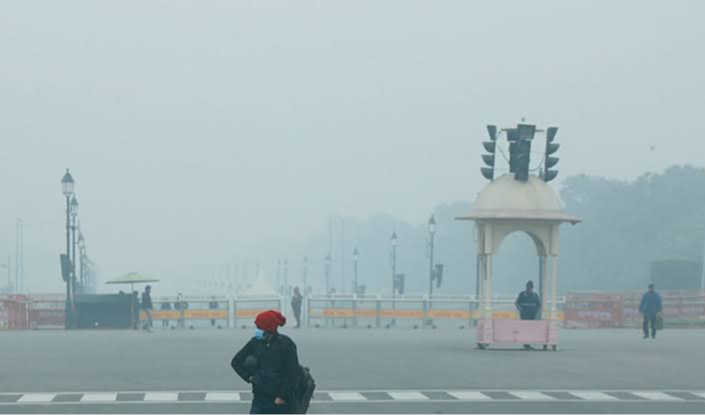
Delhi is preparing to implement a series of stricter pollution-control measures as air quality deteriorates ahead of the winter season. With the capital recording an Air Quality Index (AQI) of 179 on October 20, the Delhi government has announced restrictions covering vehicles registered outside the city, fuel supply to vehicles without valid pollution certificates, construction activities and office attendance.
Chief Minister Rekha Gupta’s winter pollution action plan introduces several deadlines between November 2026 and January 2027. The measures are intended to reduce vehicular emissions, limit dust pollution and ease traffic congestion during a period when air quality in the national capital typically faces additional pressure.
According to the Air Quality Early Warning System, Delhi’s air quality was expected to deteriorate into the ‘poor’ category and remain there until October 23. Although the AQI reading of 179 falls within the ‘moderate’ category, the forecast has increased attention on preparations for the winter pollution season.
The restrictions will not all begin simultaneously. November 1 marks the start of several major measures, December 10 is the scheduled beginning of a complete construction and demolition ban, and January 31 is the final date for certain vehicle restrictions and broader construction-related curbs.
November 1: Restrictions on Certain Vehicles and Fuel Without a Valid PUCC
The first major deadline under Delhi’s winter pollution action plan is November 1, 2026. From that date, vehicles registered outside Delhi that do not comply with Bharat Stage VI (BS-VI) emission standards will face restrictions on entering the capital.
The restriction is scheduled to remain in force until January 31, 2027. Compressed natural gas (CNG) vehicles and electric vehicles (EVs) will be exempt from this particular measure.
The policy is aimed at limiting the entry of certain older or higher-emission vehicles into Delhi during the winter pollution period. Motorists travelling into the capital will need to check their vehicles’ registration details and applicable emission standards before planning their journeys.
The government has also announced a ‘No Pollution Under Control Certificate, No Fuel’ policy. Under this measure, petrol pumps will be prohibited from supplying fuel to vehicles that do not have a valid Pollution Under Control Certificate (PUCC).
A valid PUCC serves as evidence that a vehicle has undergone the prescribed pollution-emission test. The new fuel restriction is intended to encourage vehicle owners to keep their certification current and ensure that vehicles comply with applicable pollution-control requirements.
Automatic Number Plate Recognition (ANPR) cameras are also planned at fuel stations to strengthen monitoring and enforcement. Such systems can assist authorities in identifying vehicle registration numbers and supporting checks under the policy.
The announcement, however, does not provide the complete enforcement procedure for all affected vehicles or specify the penalties that would apply in every case. Motorists should therefore follow official implementation instructions as they become available.
Construction Activities to Face Tighter Controls
Construction and demolition work will also come under stricter scrutiny as part of the winter pollution strategy. Dust generated by construction sites, demolition operations and outdoor civil works can contribute to particulate pollution, making these activities an important target for seasonal restrictions.
From November 1, 2026, the government plans to impose broader restrictions on demolition and outdoor civil construction activities that generate dust. These restrictions are scheduled to continue until January 31, 2027.
Authorities also plan to use artificial intelligence-enabled cameras to monitor dust at construction sites. The proposed surveillance system is intended to strengthen oversight and help identify activities that may violate pollution-control requirements.
The measures could affect builders, contractors, property owners and infrastructure projects that depend on outdoor construction or demolition work. Project operators may need to review their schedules and ensure that their activities comply with the applicable restrictions.
The government’s announcement, as reported by The Economic Times, does not provide a comprehensive list of exemptions or detailed penalties for every category of construction-related violation.
December 10 to January 20: Complete Construction and Demolition Ban
The strictest scheduled construction restriction is due to begin on December 10, 2026. A complete ban on construction and demolition work is planned to remain in force until January 20, 2027.
This period falls within the winter months when Delhi’s pollution-control measures are intended to be strengthened. By temporarily stopping construction and demolition activities, the government aims to reduce dust emissions during a particularly sensitive part of the season.
The December 10 deadline is distinct from the broader restrictions scheduled to begin on November 1. The earlier measures target dust-generating demolition and outdoor civil construction activities, while the December-January measure is described as a complete construction and demolition ban.
The scheduled end dates also differ. The complete ban is due to end on January 20, whereas the wider restrictions on specified dust-generating activities are scheduled to continue until January 31.
Construction companies and project managers will need to account for these separate dates when planning work. The announcement does not specify whether any categories of projects will qualify for exemptions, so the precise scope of implementation will depend on the applicable official directions.
January 31: Final Day for Certain Vehicle and Construction Restrictions
January 31, 2027, is the scheduled final day of the restrictions on non-BS-VI vehicles registered outside Delhi, subject to the stated exemptions for CNG and electric vehicles.
The date also marks the scheduled end of the broader restrictions on dust-generating demolition and outdoor civil construction activities introduced on November 1.
However, the end of January will not mark the conclusion of Delhi’s entire winter pollution action plan. According to the reported announcement, most other measures are intended to remain in force until February 28, 2027.
This means residents, businesses and commuters should not assume that all pollution-control requirements will end when the specific vehicle restrictions expire. Different measures have different implementation periods, and their continuation will depend on the government’s announced schedule and any subsequent directions.
Offices May Reduce In-Person Attendance by 50%
The winter pollution plan also includes measures aimed at reducing the number of daily commuters. The government has called for government and private offices to reduce their in-person workforce by 50%, with work-from-home arrangements intended to help limit commuting and traffic-related emissions.
Reducing the number of employees travelling to workplaces could help ease congestion during peak hours and lower the volume of vehicles on Delhi’s roads. The approach complements the restrictions on certain vehicles and the proposed changes to office timings.
The government has announced staggered working hours for its offices.
Municipal Corporation of Delhi (MCD) offices are scheduled to operate from 8:30 am to 5 pm, while Delhi government offices are scheduled to function from 10 am to 6:30 pm.
The different schedules are intended to distribute traffic across a wider period rather than concentrating journeys around the same start and finish times.
The reported announcement does not provide detailed instructions explaining how the 50% in-person attendance target will be monitored across private employers. Further implementation guidance may be necessary to clarify how workplaces are expected to comply.
Why Delhi Is Strengthening Pollution Controls
Delhi’s preparations come as the capital approaches the period when air pollution frequently becomes a major public concern. The combination of emissions from vehicles, dust-generating activities and seasonal conditions can place additional pressure on air quality.
The Air Quality Early Warning System forecast that Delhi’s AQI would remain in the ‘poor’ category until October 23. The forecast indicates a potential deterioration from the moderate conditions recorded on October 20.
Under the Central Pollution Control Board’s AQI classification, readings between 101 and 200 fall in the moderate category, while readings between 201 and 300 are classified as poor. Delhi’s reported AQI of 179 was therefore moderate, even as forecasts pointed towards worsening conditions.
Weather conditions can influence how pollutants disperse or accumulate. The weather department forecast no rainfall over the following week, according to the report. The absence of rain may reduce opportunities for precipitation to remove some airborne particles, although actual pollution levels also depend on wind, atmospheric conditions and the sources of emissions.
Crop-residue burning in neighbouring states is another seasonal factor attracting attention. Data from the ICAR-Indian Agricultural Research Institute recorded 19 crop-residue-burning incidents across six monitored states earlier in October. The reported figures included seven incidents each in Punjab and Uttar Pradesh, four in Madhya Pradesh and one in Haryana.
These incidents form part of the wider regional context surrounding Delhi’s winter air quality. The figures alone do not establish how much pollution reached the capital or how much of its AQI was attributable to agricultural fires.
What Residents and Businesses Should Know
Delhi’s winter pollution plan combines vehicle restrictions, pollution-certificate checks, construction controls and measures to reduce commuting. Residents and businesses will need to pay attention to the different dates because each restriction has its own schedule.
Motorists should check that their PUCC is valid and verify whether vehicles registered outside Delhi meet the applicable BS-VI requirements before entering the capital from November 1.
Builders and contractors should prepare for restrictions on dust-generating activities beginning November 1 and the planned complete construction and demolition ban from December 10 to January 20.
Employers will need to monitor the government’s instructions on reduced in-person attendance and staggered office timings. Commuters may also need to adjust their travel arrangements as workplace schedules and vehicle restrictions take effect.
The reported action plan is scheduled to continue into February 2027, although individual measures will begin and end on different dates. The government’s ability to implement and enforce these restrictions, along with compliance by motorists, construction operators and employers, will be important to their effectiveness.
As Delhi moves towards winter, the central challenge will be to translate the announced measures into consistent action across transport, construction and workplace activity. The AQI forecast has placed the capital’s pollution preparations firmly in focus, while the coming months will show how the restrictions affect emissions and air quality.