Search

    Language Settings
    Select Website Language

    GDPR Compliance

    We use cookies to ensure you get the best experience on our website. By continuing to use our site, you accept our use of cookies, Privacy Policy, and Terms of Service.

    PM Modi Tells Putin World Must Move From Endless War to an End of War

    17 hours ago

    Yugcharan News / 01-09-2026

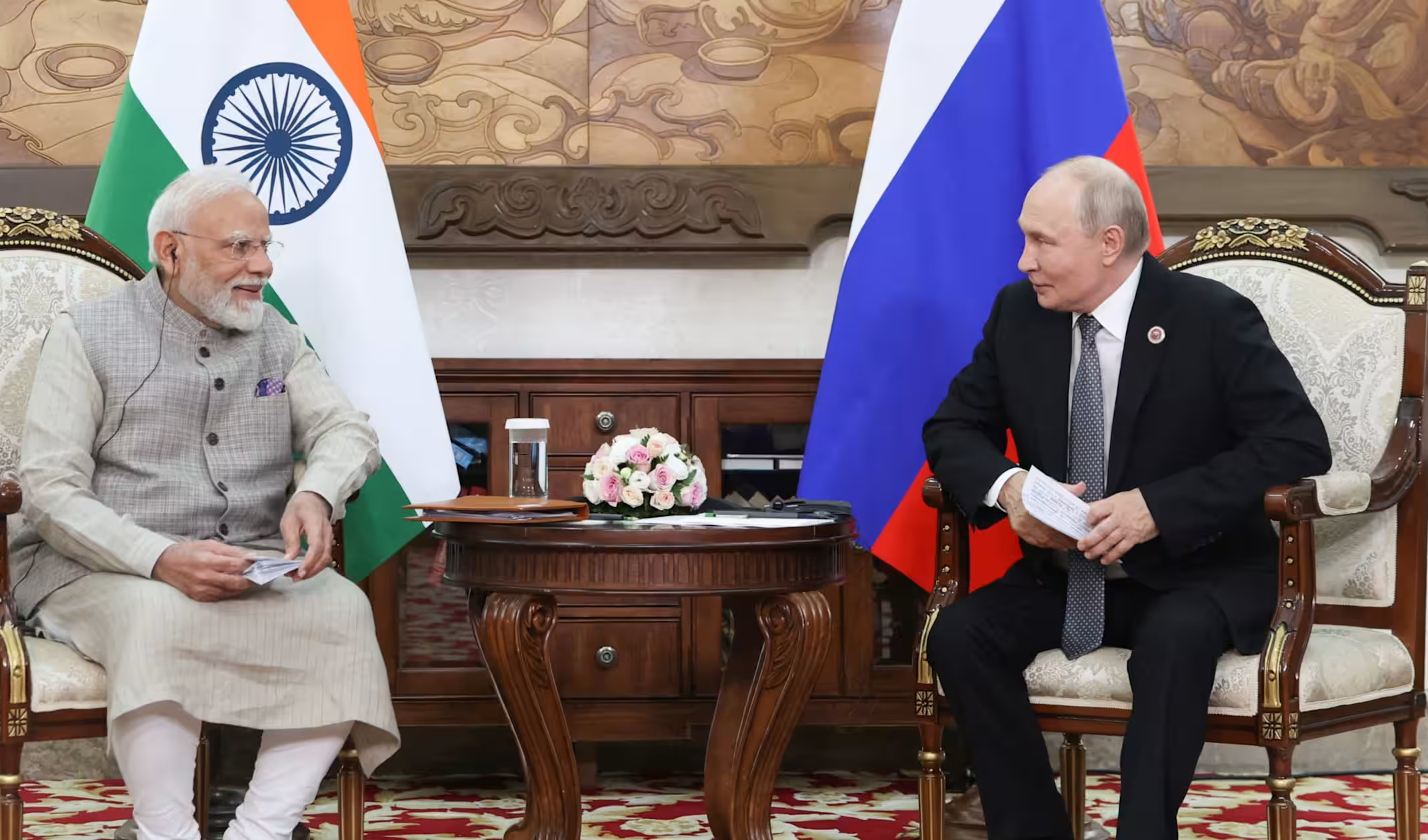
    Prime Minister Narendra Modi has called for a shift from prolonged conflicts towards lasting peace, telling Russian President Vladimir Putin that the international community must work towards ending wars rather than allowing them to continue indefinitely. The remarks came during a meeting between the two leaders on the sidelines of the Shanghai Cooperation Organisation (SCO) summit in Bishkek, Kyrgyzstan, on August 31.

    During the meeting, Modi stressed the importance of finding peaceful solutions to international conflicts and underlined the role of dialogue and diplomacy in resolving disputes. His comments came at a time when several regions continue to face serious security challenges, including the ongoing conflict involving Russia and Ukraine and tensions affecting the wider West Asian region.

    According to the information released by the Ministry of External Affairs, Modi and Putin discussed a number of international developments during their meeting. Their talks included the situation surrounding the conflict in Ukraine as well as developments in West Asia and the Black Sea region.

    The Black Sea situation has particular relevance for India because Indian seafarers operating in the region have faced security risks amid the continuing hostilities. The Ministry of External Affairs said the two leaders discussed concerns arising from attacks involving Indian mariners in the region.

    Modi Emphasises Dialogue and Diplomacy

    The Prime Minister's message reflected India's longstanding position that conflicts should ultimately be addressed through dialogue and diplomatic engagement. Rather than allowing wars to become prolonged, Modi called for international efforts aimed at creating conditions for their conclusion.

    The statement that the world must move from “endless war” to an “end of war” highlighted the broader humanitarian and economic consequences of continuing conflicts. Prolonged wars can affect not only the countries directly involved but also global trade, shipping routes, energy markets, food supplies and the safety of people working in affected regions.

    For India, the security of its citizens and nationals working overseas remains an important concern. Indian seafarers are employed across international shipping routes, including areas affected by geopolitical tensions. Any disruption or attack in strategically important maritime regions can therefore have consequences beyond the immediate conflict zone.

    The discussions between Modi and Putin also come against the backdrop of India's effort to maintain diplomatic engagement with multiple sides of major international disputes. New Delhi has consistently advocated dialogue while maintaining relations with countries involved in competing geopolitical blocs.

    Ukraine Conflict Remains a Major International Concern

    The Russia-Ukraine conflict was among the important issues discussed by Modi and Putin. The war has had consequences well beyond Eastern Europe, contributing to changes in international trade patterns, shipping routes, energy markets and diplomatic relations.

    India has repeatedly maintained that dialogue and diplomacy are essential for resolving the conflict. New Delhi has also sought to preserve communication with both Russia and Western countries, while emphasising the importance of national interests and global stability.

    Modi's latest comments reinforce that approach. By stressing the need to move towards an end to war, India is again placing emphasis on a diplomatic pathway rather than a military solution.

    The Prime Minister's interaction with Putin is also significant because Russia remains an important partner for India in areas including defence, energy and broader strategic cooperation. At the same time, India has continued to engage with European countries, the United States and other partners on economic, security and technological issues.

    This balancing approach has made India's diplomatic engagement particularly important as geopolitical divisions have deepened in recent years.

    Security of Indian Mariners Discussed

    One of the specific concerns raised during the discussions was the safety of Indian seafarers operating in and around the Black Sea region.

    The maritime sector has been affected by the broader geopolitical situation, with vessels and crews facing increased risks in areas where military operations or security incidents are taking place. For India, the issue is particularly sensitive because a significant number of Indian nationals work in the global shipping industry.

    Any attack involving commercial vessels can potentially disrupt international supply chains and create safety concerns for crew members. India has therefore continued to monitor developments affecting its citizens and maritime interests.

    The discussion between Modi and Putin indicates that the safety of Indian nationals remains part of India's diplomatic engagement with countries directly connected to international conflicts.

    The concerns surrounding the Black Sea also demonstrate how regional conflicts can have global consequences. A military confrontation in one geographical area can affect shipping insurance, freight costs, delivery schedules and the movement of essential commodities around the world.

    West Asia Also Figures in Talks

    The two leaders also discussed developments in West Asia, another region facing significant instability and geopolitical tensions.

    The situation in West Asia has broader implications for India because of the country's economic, energy and people-to-people connections with the region. Millions of Indians live and work in West Asian countries, while the region remains important for India's energy requirements and international trade.

    India has repeatedly called for peace and stability in the region and has emphasised the need to protect civilians and maintain freedom of navigation. The country's diplomatic approach has focused on maintaining communication with different parties while advocating peaceful resolution of disputes.

    The inclusion of West Asian developments in the Modi-Putin discussions demonstrates the wide-ranging nature of the bilateral engagement. The meeting was not limited to relations between India and Russia but also covered major international issues affecting global security.

    SCO Summit Provides Platform for Diplomatic Engagement

    The meeting between Modi and Putin took place during the SCO summit in Bishkek, providing an important platform for discussions among leaders from member countries.

    The Shanghai Cooperation Organisation has become a significant forum for dialogue on regional security, economic cooperation and political developments across Eurasia. Meetings on the sidelines of such summits often provide leaders with opportunities to discuss bilateral issues as well as international developments.

    For India, participation in multilateral organisations such as the SCO is part of a wider diplomatic strategy aimed at maintaining engagement with major powers and regional partners.

    Modi's meeting with Putin therefore carried significance both in terms of India-Russia relations and the broader international conversation about conflicts and peace.

    India's Consistent Position on Peace

    India's emphasis on dialogue and diplomacy has been a recurring feature of its position on international conflicts. New Delhi has argued that lasting solutions require negotiations and that military confrontation alone cannot provide sustainable peace.

    Modi's latest message to Putin follows that broader diplomatic approach. His call for the world to move away from endless wars reflects concerns about the long-term impact of conflicts on humanity and international stability.

    The remarks also underline India's preference for diplomatic engagement at a time when the global security environment remains highly uncertain. Conflicts in different parts of the world have increasingly become interconnected through trade, energy, maritime transportation and international diplomacy.

    As the Russia-Ukraine conflict continues to influence global affairs and instability remains a concern in West Asia and the Black Sea, India's advocacy of dialogue is likely to remain an important component of its foreign policy.

    The meeting between Modi and Putin ultimately highlighted India's focus on peace, diplomacy and the protection of its citizens and economic interests. While the discussions do not by themselves represent a resolution to the conflicts under consideration, they demonstrate the continued importance of direct diplomatic engagement among major countries.

    For India, the message remains clear: international disputes should not be allowed to become permanent sources of instability, and diplomatic channels must remain open in the search for peaceful and lasting solutions.


    The details of the meeting and the issues discussed were reported by the source article provided for this report. 

    Click here to Read More
    Previous Article
    वैदिक संस्कृति संवर्द्धन हेतु ऐतिहासिक सहयोग; राजस्थान मन्त्र प्रतिष्ठान में यज्ञ पात्रों के लिए सुप्रीम फ़ाउंडेशन, जसवंतगढ़ ने ₹2.25 लाख की आर्थिक सहायता स्वीकृत
    Next Article
    Nepal Flood Death Toll Crosses 900 as Rescue Teams Search for Survivors in Devastated Border Region

    Related National Updates:

    Are you sure? You want to delete this comment..! Remove Cancel

    Comments (0)

      Leave a comment