Yugcharan News / 22-10-2026
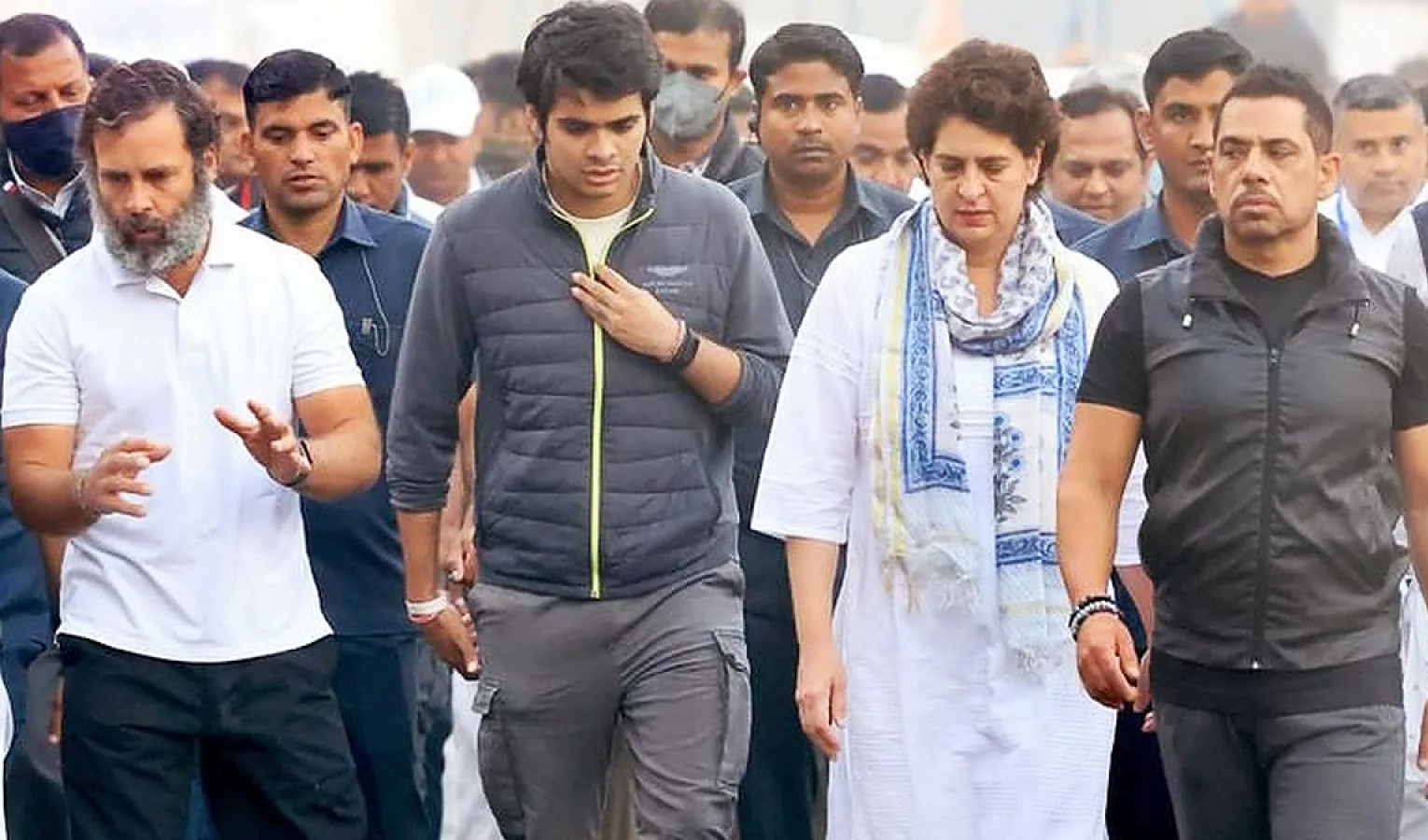
Visual artist and curator Raihan Rajiv Vadra, son of Congress leader Priyanka Gandhi Vadra and businessman Robert Vadra, has alleged that authorities at Bikaner House in New Delhi directed him to remove or replace 74 of the 105 photographs planned for his exhibition, No Idea Is Final, just hours before its scheduled opening on Wednesday. The photographs included images documenting recent student and youth protests in the national capital, as well as pictures featuring the Indian national flag. Vadra criticised the restrictions, arguing that limitations on artistic expression were inappropriate and that public cultural spaces had a responsibility to serve society.
The controversy emerged on October 21, when Vadra’s exhibition was due to open at Bikaner House. According to his account, the authorities raised objections to a substantial portion of the displayed works shortly before the opening, leaving his team with limited time to respond. By the evening, only around 35 exhibits remained, and officials also objected to blank frames that had been placed in place of the removed photographs.
The episode has raised questions about the relationship between artistic freedom, institutional policies and the use of public cultural venues. However, the officials at Bikaner House had not issued an immediate response to requests for comment, according to the report.
Artist Says 74 Photographs Were Flagged Before Opening
Vadra said the first objection to the exhibition was raised at around 6 pm on the day before the show was scheduled to open. He said he was informed that the authorities would get back to him regarding their concerns.
According to Vadra, the first written objection arrived at approximately 3.30 pm on Wednesday, only three hours before the exhibition was due to open. He said the communication gave him 30 minutes to remove or replace 74 of the 105 photographs.
The short deadline left little time for the artist and his team to make changes to the exhibition. Vadra said the explanation communicated to him was that the timing and context of the works were inappropriate and that the photographs were overtly political.
He also said he was told that, with heightened security arrangements across Delhi, it was not the appropriate time to display such images.
The available information does not include the full written objection issued by the authorities or an independent assessment of the reasons behind each photograph being flagged. The account of the restrictions has primarily been presented through Vadra’s statements.
The scale of the requested changes nevertheless meant that a large majority of the planned photographs could not be displayed as originally intended.
Blank Frames Also Drew Objections
After the photographs were taken down, Vadra’s team reportedly replaced them with blank frames. The artist said the authorities subsequently objected to those frames as well and directed that they be removed.
In a statement circulated at the exhibition venue, Vadra described the sequence of events and questioned the manner in which the restrictions had been imposed.
The dispute over the blank frames added another dimension to the controversy. Rather than simply altering the selection of photographs, the removal of the replacement frames affected how the exhibition could be presented after the original works had been taken down.
Vadra said he had shared the exhibition layout with the venue on October 15. He claimed that officials later told him the layout was not legible or readable.
He also maintained that he had already removed photographs containing political slogans because the venue had a policy against political content.
According to Vadra, he had not been told in advance that every artwork would be reviewed individually, nor had the organisers been asked to submit all the photographs for prior scrutiny.
These claims raise questions about the communication between the exhibition organisers and the venue before the opening. The available report, however, does not contain a detailed response from Bikaner House explaining its review process or its interpretation of the applicable policy.
Photographs Documented Six Months of Public Movements
Vadra said the photographs at the centre of the dispute documented public movements in Delhi over the preceding six months. He described the collection as an attempt to capture demonstrations and gatherings through the ideas of movement and rhythm.
The 26-year-old artist said he approached the photographs both as a participant and as an observer. He described the experience of capturing large gatherings from within as an opportunity to observe the visual patterns and expressive qualities that emerge during public movements.
His comments suggest that the exhibition was intended to explore more than the political messages associated with demonstrations. The photographs were also meant to examine the visual and collective dimensions of public gatherings.
Vadra argued that displaying these images was a responsibility he felt he had as both a citizen and an artist.
“As a citizen and an artist, for me it was my duty to take and display these images,” he said, adding that restrictions on art were wrong and futile.
He also expressed the view that artistic work would find ways to reach audiences despite attempts to restrict its display.
The photographs formed part of No Idea Is Final, an exhibition that brought together different subjects and styles rather than concentrating exclusively on political events.
Images of the National Flag Among Those Removed
One of the aspects that particularly surprised Vadra was the reported objection to photographs featuring the Indian national flag.
He said he was shocked that these images had also been included among the works that officials wanted removed. Vadra maintained that he objected to their removal and told the authorities that he would not take them down himself.
According to his account, the images were removed by others after he had left the premises.
The available information does not establish the specific reasons the authorities gave for objecting to these particular photographs. It also does not include a detailed explanation from the venue regarding whether the objection was based on the images themselves, their context within the exhibition or a broader assessment of the collection.
The inclusion of the flag photographs became a significant element of the dispute because it broadened the discussion beyond images of protests and political slogans.
Vadra questioned the venue’s approach to artistic content and said he found both the decision and the policy itself strange. In his view, all art has a political dimension, even when it is not explicitly presented as political commentary.
His remarks reflect his personal assessment of the role of art and should be distinguished from the venue’s formal position, which had not been made available in a detailed public response at the time of reporting.
Priyanka Gandhi Vadra Criticises the Move
Congress leader Priyanka Gandhi Vadra, Raihan’s mother, also criticised the removal of the photographs.
According to a report by the Press Trust of India, she described the decision as ridiculous and said it amounted to muzzling the voice of young people across the country.
She warned that restrictions affecting one artist could have consequences for others in the future.
Her response brought a political dimension to the controversy, given her position as a prominent Congress leader. However, the dispute itself concerns the restrictions allegedly imposed on an art exhibition and the policies governing the display of works at Bikaner House.
The episode has therefore become a point of discussion around artistic expression and institutional decision-making. The absence of an immediate response from the venue means that the rationale behind the restrictions remains incompletely documented in the available reporting.
A full assessment of the dispute would require the written objections, the relevant venue policy and the authorities’ explanation of why particular photographs were considered unsuitable for display.
Artist Questions Responsibilities of Public Cultural Spaces
Vadra said the incident had changed how he viewed the responsibilities of public cultural venues.
He argued that such institutions should serve not only the people who own or manage them but also the wider public. In his view, removing artworks because they might offend or disrupt an audience was wrong.
His comments raise a broader question about how cultural institutions balance their own rules with the artistic freedom of exhibitors.
Venues may establish policies governing the content displayed on their premises. However, when restrictions are imposed shortly before an exhibition opens, the timing and transparency of the decision can become as important to the dispute as the substance of the policy itself.
In this case, Vadra’s account centres on the timing of the objections, the number of photographs affected and the limited period given to make changes.
The venue’s response will be important in determining how the review was conducted, whether the exhibition proposal was assessed against established guidelines and why the concerns were communicated so close to the opening.
Without that information, the complete institutional reasoning behind the decision cannot be independently established.
Exhibition Brings Together Different Photographic Subjects
Vadra described No Idea Is Final as a departure from his earlier approach to curating exhibitions.
He said that, in previous projects, he had generally developed a narrative first and then selected artworks to fit that theme. For the current exhibition, he instead chose works that spoke to him individually before organising them around a broader theme.
The collection included photographs of wildlife, public movements and abstract subjects. This range indicates that the exhibition was not designed solely as a documentation of political protests, even though the photographs of public demonstrations became the focus of the controversy.
Vadra has also founded the Usual Suspects gallery and the You Cannot Miss This art collective, according to the report.
The remaining works at Bikaner House were scheduled to remain open to the public until October 25. Vadra said on Instagram that he intended to display the complete collection at another venue in the future.
That plan could allow audiences to view the photographs that were not displayed at Bikaner House, although no alternative venue or date had been announced in the available information.
Questions Remain Over the Decision
The dispute over No Idea Is Final has brought attention to the circumstances under which artwork can be restricted at a cultural venue, particularly when the works depict recent public events.
Vadra has alleged that he received the written objection only hours before the exhibition opened and was given 30 minutes to remove or replace 74 photographs. He has also questioned the objections to the blank frames and the removal of photographs featuring the national flag.
Priyanka Gandhi Vadra has criticised the decision, while Bikaner House officials had not provided an immediate response to requests for comment.
The precise grounds for the restrictions, the process followed by the venue and the reasons individual photographs were flagged remain unclear from the available information.
For now, the exhibition continues with a reduced selection of works, while Vadra has indicated that he plans to present the entire collection elsewhere. The episode has placed artistic expression, institutional policies and public access to cultural spaces at the centre of a wider debate, with further clarification from the venue likely to be important to understanding the dispute fully.