Search

    Language Settings
    Select Website Language

    GDPR Compliance

    We use cookies to ensure you get the best experience on our website. By continuing to use our site, you accept our use of cookies, Privacy Policy, and Terms of Service.

    Trump Pledges $5,000 ‘Dividend’ for Every Adult U.S. Citizen if Republicans Win Midterm Elections

    11 hours ago


    Yugcharan News / 10-09-2026

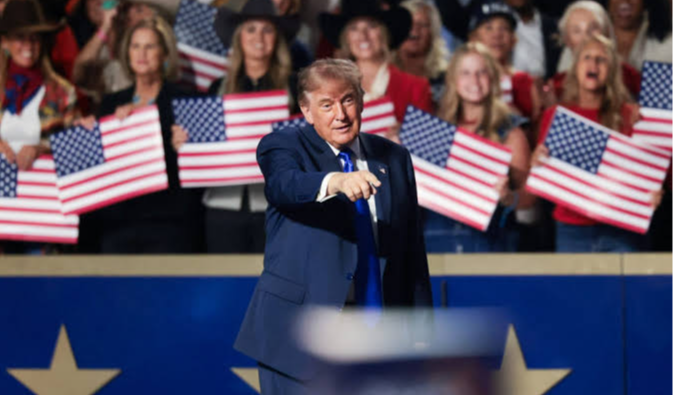
    U.S. President Donald Trump has promised a potential $5,000 government-funded “dividend” for every adult American citizen if Republicans succeed in retaining control of both the House of Representatives and the Senate in the November midterm elections. The announcement came during a major Republican gathering in Dallas, where Trump sought to energise his party’s supporters and urged voters to treat the upcoming elections as though he himself were on the ballot.

    The proposal, which Trump referred to as the “Trump Dividend,” immediately drew attention because of its enormous potential cost and the absence of detailed information about how such a payment would be financed, administered or legally implemented. Trump presented the proposed payment as a reward for Americans, arguing that the country was generating substantial revenue and that his administration’s economic policies had created the conditions for such a distribution.

    Speaking to Republican supporters, Trump said the payment would be made to every adult citizen if Republicans won both chambers of Congress. He compared the idea with the way successful companies distribute cash to their shareholders, portraying American citizens as beneficiaries of the country’s economic performance.

    However, the president did not provide a detailed policy framework for the proposal. It remains unclear what government programme or source of revenue would finance the payments, when eligible citizens would receive the money, how eligibility would be determined and what mechanism would be used to distribute the funds.

    Trump also indicated that the proposed $5,000 payment would come with a specific condition: the money would have to be spent inside the United States. He did not explain how the government would monitor or enforce that requirement.

    The proposal comes as Trump and Republicans attempt to make economic issues a central part of their campaign for the midterm elections. The president’s appearance in Dallas was aimed at strengthening Republican support and encouraging voters to participate in races that could determine control of Congress.

    Trump acknowledged during his remarks that Republicans might not win the elections. Nevertheless, he urged supporters to back Republican candidates and said that if the party prevailed, voters would benefit from the proposed dividend.

    The president also used the speech to attack Democrats, arguing that his administration’s tariff policies had helped generate government revenue. He claimed Democrats would not be able to offer a similar payment because, in his view, they did not pursue tariffs or policies designed to bring additional money into government coffers.

    The scale of the proposed payment is one of the biggest questions surrounding Trump’s announcement. Estimates cited in the source report suggest that a nationwide distribution could involve hundreds of millions of adults and potentially require more than $1 trillion in government spending.

    U.S. Census Bureau data cited in the report indicate that the country has nearly 260 million adults. That figure includes both American citizens and non-citizen residents, meaning the number of people ultimately eligible under Trump’s proposal would be lower if the payment were restricted exclusively to adult citizens, as he stated.

    An NBC News estimate cited by Forbes put the potential overall cost of the proposed payments at approximately $1.35 trillion. Such a figure would make the programme one of the most expensive direct-payment initiatives ever proposed by a U.S. president.

    The financial implications raise questions about whether the government could afford such a programme without significant changes to federal revenues, spending or borrowing. Trump did not address those questions in detail during his speech.

    There are also legal and constitutional questions surrounding the proposal. Trump specifically linked the payment to a Republican victory in both the House and Senate. The legality of conditioning a federal payment on the electoral success of a particular political party remains unclear.

    For the proposal to become a functioning government programme, Congress would likely have to play an important role in determining how the payments are authorised and funded. The president’s remarks did not include details about legislation that would establish the programme or about whether congressional Republicans had already developed a formal plan.

    The announcement therefore remains a political pledge rather than an established government benefit. No indication was provided that eligible citizens would automatically receive the money, and there is currently no confirmed payment schedule.

    Trump’s decision to unveil the proposal at a Republican political convention also underlines its electoral significance. His speech lasted nearly two hours, with the president positioning himself as a central figure in the Republican campaign for the midterms. He told supporters to imagine that his name was on the ballot and urged them to vote accordingly.

    Trump suggested that around 35 House and Senate seats could be decisive in determining which party controls Congress. He said he intended to campaign in states where races were particularly competitive, including areas where candidates were leading by narrow margins, trailing slightly or effectively tied.

    The proposed dividend was therefore presented alongside a broader political appeal to Republican voters. Trump’s message was that a Republican victory in Congress would allow his administration to continue pursuing its economic agenda and potentially deliver direct financial benefits to citizens.

    The speech also covered international affairs, including the ongoing conflict involving Iran. Trump defended the U.S. position in the war and claimed that Iran could be only weeks away from obtaining a nuclear weapon. He expressed confidence that the United States would ultimately prevail.

    The combination of domestic economic promises and foreign-policy issues reflects the broad range of themes Trump is expected to use as Republicans campaign for the midterm elections.

    The $5,000 dividend proposal, however, is likely to remain one of the most closely examined elements of the speech because of its potential impact on federal finances and American households.

    If implemented, a payment of $5,000 would represent a significant one-time financial boost for millions of eligible Americans. For households facing high living costs, housing expenses, healthcare bills and other financial pressures, such a payment could provide immediate relief. At the same time, the enormous aggregate cost means that questions over funding would be central to any serious discussion about the proposal.

    Trump’s argument is that the government has benefited substantially from the country’s economic performance and tariff revenues and could therefore return some of that money to citizens. Whether those revenues would actually be sufficient to finance payments of $5,000 to hundreds of millions of people remains a major unresolved issue.

    Another important question concerns the spending requirement. Trump said recipients would have to use the money within the United States, potentially turning the proposed dividend into a tool for encouraging domestic consumption. Increased spending could theoretically benefit American businesses, retailers and service providers, but the proposal did not explain how purchases made abroad would be identified or prevented.

    The announcement also comes at a time when Trump’s political standing has faced challenges. The source report noted that his approval ratings have remained under pressure, while some support among Republican voters has also weakened. His decision to make himself a central part of the midterm campaign suggests that he views his personal political influence as important to Republican efforts to maintain control of Congress.

    For now, the “Trump Dividend” remains a promise rather than an approved federal programme. Important questions surrounding its funding, eligibility rules, legal authority, administration and enforcement remain unanswered.

    The proposal nevertheless gives Republicans a potentially powerful campaign message focused directly on household finances. Whether it becomes a serious legislative initiative after the elections will depend heavily on the outcome of the November vote and the ability of the administration and Congress to establish a legally and financially workable mechanism.

    As the midterm campaign progresses, the proposed $5,000 payment is likely to become part of a larger debate over tariffs, government revenue, federal spending and the role of direct payments in economic policy. For American voters, the central question will be whether the promised dividend can move beyond a campaign pledge and become a realistic, funded government programme.

    Until further details are released, the “Trump Dividend” should be viewed as an electoral promise whose financial and legal framework has yet to be established.

    Click here to Read More
    Previous Article
    Xi Jinping’s India Visit May Ease Diplomatic Tensions, but Business Relations Still Face Deep Trust Deficit
    Next Article
    US DHS ‘Self-Deport’ Advertisement Targeting ‘Mr Singh’ Sparks Controversy

    Related International Updates:

    Are you sure? You want to delete this comment..! Remove Cancel

    Comments (0)

      Leave a comment